2 The Mechanisms, and the Integrator
At the end of the last chapter the collector was the integrator, holding a kit of separate instruments together by hand. The change this whole system turns on is simple to state. You hand that job to the phone. Back on the same slope, with the same plant, you do one thing now instead of many. You take a photograph.
The photograph is the record. Not a picture of the record, the record itself, made by pointing a camera and pressing once. And it doesn’t come bare. The phone writes into the picture where it was taken and when, the latitude and longitude from its GPS and the time from its clock, and it does this whether or not you think about it. The two things the old notebook got wrong most often, the location and the date, are now the two things you can’t get wrong. They arrive for free, and they arrive correct.
Think about what that coordinate pair is worth. The altimeter, the clinometer, the compass, the topographic map, all of that kit measured things that are fixed by where you’re standing: the elevation, the slope, the aspect, the name of the place. But if the coordinates are already in the photograph, none of those instruments has to be carried, because every one of those numbers can be looked up afterward from the coordinate pair alone. The elevation of a point is a matter of public record. So is its slope, its aspect, the rock beneath it, the name of the valley. These sit in open data that anyone can reach, free and without permission, so the answer comes out the same whoever asks. The whole instrument kit collapses into a single number you already have, and a quiet lookup later. We’ll come back to how that lookup works. For now it’s enough that the instruments are gone.
That clears away everything the landscape can supply. What’s left is the part it can’t: the things true only of this plant, at this moment, in front of you. Whether it’s flowering. Its habit, low and spreading or single-stemmed and tall. The color of the petals before they fade on the sheet. No coordinate will ever tell you these. Someone has to look at the plant and judge. And judging isn’t the problem. Writing the judgment down is the problem, the same slow, wet, illegible friction from before. So the question narrows to a fine point: how do you record a choice without writing it? You photograph it. Not the plant, the choice itself.
This is where the QR code comes in, and it’s worth stopping to say plainly what one is, because nearly everyone has the wrong idea. A QR code, to most people, is a link you scan to open a website. That’s a habit, not a definition. A QR code is only a way of printing a short piece of text so a camera can read it back. It can hold a web address, and usually does, but that’s convention, not law. Ours holds plain words. A small printed card carries the words “Life Form: Tree,” and under them the same words as a code. You don’t scan the card to be taken anywhere. You photograph it, and later, when the picture is read, the words come back out. Scan one of our cards with an ordinary phone and it won’t fail and it won’t open a browser. It will simply show you “Life Form: Tree,” which is exactly what it says.
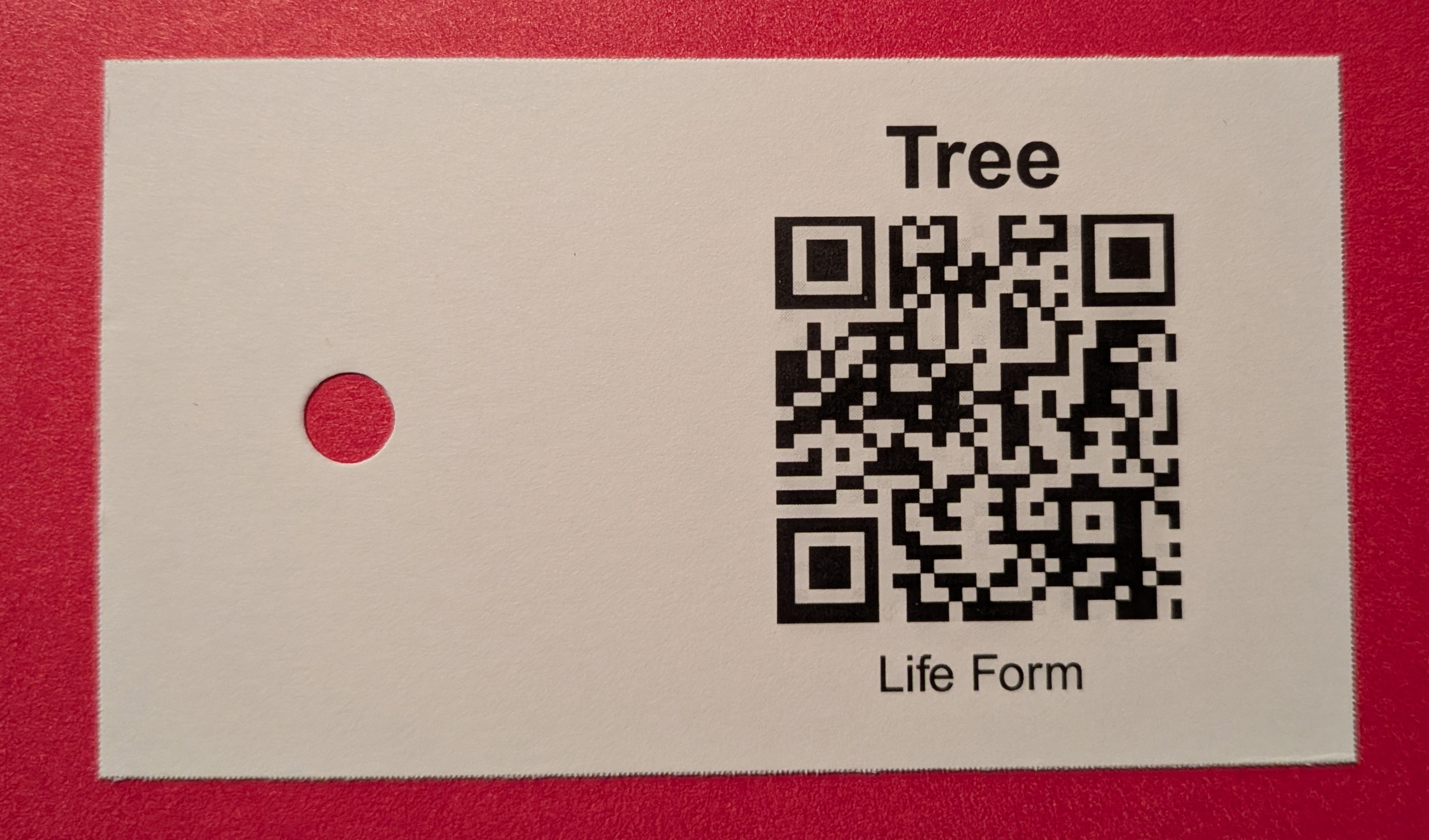
Life Form: Tree. That is the entire trick, and the rest of this book is about what becomes possible once a chosen category can be recorded by photographing it. The empty left-hand third is not waste: it is where the screw post goes. (Photograph: K. Bridges)
And here is the part that surprises people: the plant itself never has to be in the picture. By the time you’re photographing the cards, the plant is set down and out of your hands. One of the cards is its identity card, carrying the collection number that will become the specimen’s tag, and that number is the stand-in for the plant. It’s the thread from the last chapter, and it’s all the link the photograph needs. So you lay the cards out close to the plant, somewhere flat and well lit: the identity card, and the ones that apply, the life form, the flowering state, whatever the plant called for. Then you take one picture of them. Nothing wet, drippy, sticky, or pokey to wrangle in the frame, and the codes, lying flat and lit, read cleanly. Afterward the identity card is tied to the specimen and both go into the bag, so the number stays with the plant. What the cards should say, and how you know which to bring, is a question of its own, and we’ll come to it. Here the point is only this: the whole observation rides into the record on a handful of cards, keyed by a number, in one dry and unhurried shot.
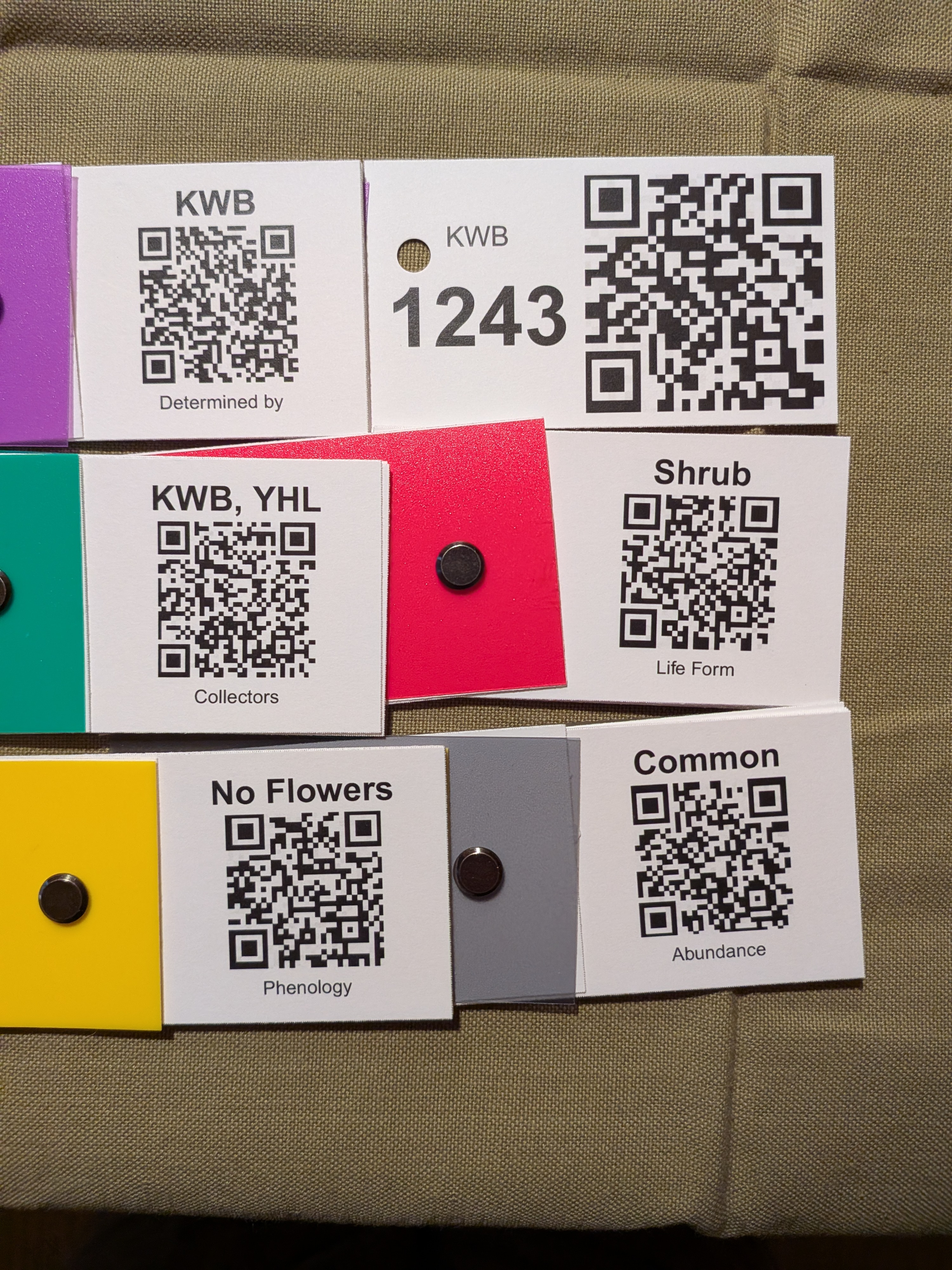
Now step back and look at the single act you performed. You took one photograph. In that one act the camera made the record, the GPS and the clock stamped it with place and time, the cards in the frame carried the observations, and the coordinate pair quietly set up everything that will later be derived. Each of these retires one of the old frictions: the camera the labor of making a record at all, the GPS the georeferencing, the cards the writing, the open data the whole instrument kit. And none of it has to be stitched together afterward, because none of it was ever taken apart. In the last chapter the integrator was you. Now it’s the phone.
That’s the shift the rest of the book is built on. One act, one record, everything bound together at the moment of collection. What that single record becomes, and how it turns into both a label and a field log without either one being written by hand, is the next thing to see. The picture is taken. Now we read it.