Voucher Labels
Capturing the field record, from the plant to the sheet
Introduction
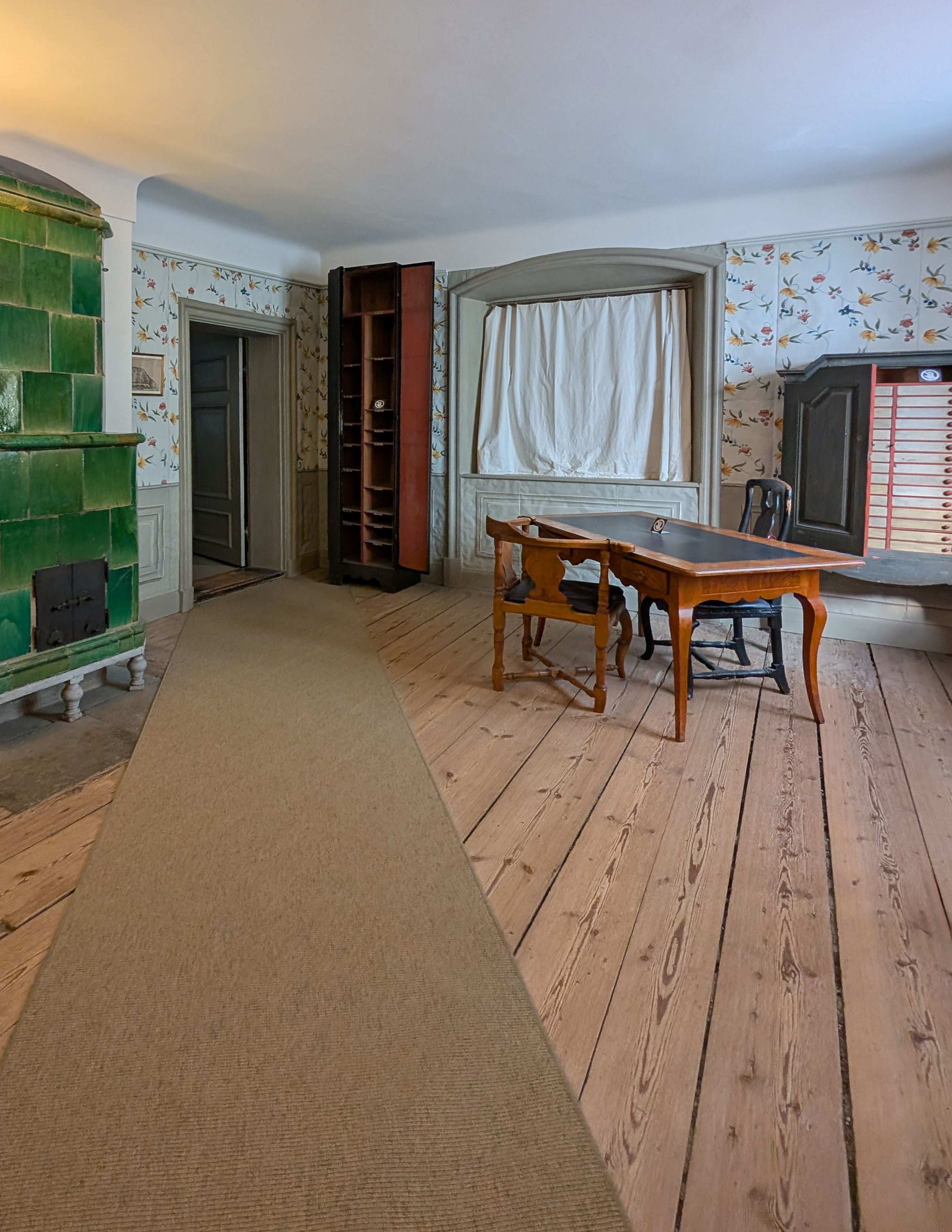
I traveled half a world to stand in this room, and I knew exactly why I’d come. It’s a plain room in Linnaeus’ summer house. A plank floor, a green tile stove in one corner, sprays of painted flowers on the walls. Against the near wall a tall cabinet stands open, its shelves the place where the pressed plants were kept, and beside it a second cabinet holds shallow drawers of insects. By the curtained window there’s a writing table and a chair. That was the equipment of the science: somewhere to keep the specimens, and somewhere to sit and write. Each cabinet is a grid of compartments, order built into furniture.
I had to stop and collect my breath. The room still holds the energy of what happened in it, and standing there you ask yourself a plain question: how do you properly respect what was done here?
Because what was done here was large. Botany was among the first of the sciences, and for most of its history its instruments stayed as simple as this table and these cabinets. Yet Linnaeus changed the field more than any instrument could, and what he gave it wasn’t a device. It was a system, a way of naming and ordering that let every plant find its place. The instrument was simple. The idea was not.
The tradition he worked in is old, and it has always belonged to many hands. Collecting a plant, pressing it, mounting it on a sheet, and writing its label is one of the first things that looks like crowd-sourced science: centuries of collectors, and the herbaria that keep the sheets, some of them for hundreds of years. A specimen gathered today joins that line. And it may outlast everyone who touches it. A sheet pressed now can be read three centuries from now, and asked a question no one alive today has thought to ask. Sheets collected only to fix a name are already being read for their DNA, for the dates they flowered, for the metals held in their tissue, for the signature of a changing climate. The collector recorded none of that on purpose. The record simply held more than its maker knew.
For most of that history, the label’s job was to say what the plant was. A name, a collector, a rough place. Plants were valued as medicine, as food, as material, and to name one correctly was nearly the whole task. So the early labels are sparse, and they were enough. That has changed. A plant is now also an indicator. It reads the climate, and it reads much else besides: the health of a soil, the arrival of a disturbance, the slow turn of a season across decades.
An indicator is only as good as its context. That a plant flowered means little until you know when it flowered, and where, and what the place was like around it. The label is where the data first land. The field notes are the context that lets the data be read. And here a modern problem appears, and it’s a recent one. We still throw the context away. The field notebook, the record of everything the label has no room for, is lost far more often than it’s kept. Ask a herbarium for the field notes behind its sheets, and too often the answer is that there are none.
The notebook isn’t lost through carelessness. It’s lost to friction. Turning a day of field scribbles into finished labels is slow, dull work, and it comes weeks or months after the trip, when the urgency has drained away. I know this from the inside, and I’ll say more about it later; the intention is always real, and the friction defeats it anyway. There’s a second loss with the same root. In fieldwork far from home, a complete copy of the record, vouchers included, should stay in the country where the plants were collected, and too often it doesn’t, because finishing the labels is friction and the friction wins. Different failures, one cause.
The response isn’t a better notebook, or a clever gadget to carry into the field. Those treat the symptom. The response is to change the structure, so the context survives by default instead of by discipline. That means a system: a way to capture, at the moment of collection, everything the record should hold, with almost none of the friction that loses it. No single technology makes this work. What makes it work is treating the whole path, from the plant in the hand to the sheet in the cabinet, as one system. It’s the same move Linnaeus made, at a smaller scale.
There’s a question hiding inside “everything the record should hold,” and it’s the one that stops people at the door. What should it hold? Of all the things you might write down about a plant, which ones earn a place, and which belong to somebody else’s work? I assumed at the start that this was a matter of judgment, that every collector would answer it differently, and that there was nothing further to say about it. That was wrong, and finding out it was wrong is the part of this work I did not see coming. The answer is already in the cabinets. Two centuries of collectors have been making that choice sheet by sheet, and every sheet is a record of what its maker thought worth writing down. Gather enough of them and the habits sort into groups, and the groups turn out to be disciplines: what a systematist records is not what an ecologist records, and never was. So this document will not hand you a set of cards to print. It will show you how to find the set your own work needs, in the record your own field has already written.
That’s the question I carried out of that room, and this document is my attempt at an answer. The tools have changed since Linnaeus kept his plants in a cabinet beside his writing table. The habit of mind has not.