6 Discovering the Decks
I said the question had an answer that wasn’t an opinion, and here it is. The answer is already in the cabinets: the decks a field needs are already written in that field’s own record. We don’t have to prescribe them. We can read them out.
Think about what two centuries of herbarium sheets actually are. Every collector, on every sheet, made a choice about what was worth writing down, a small act of expert judgment repeated millions of times. Nobody ever wrote down the pattern of those choices. But the choices themselves survived, sheet by sheet, and most of them are now digitized and public. That vast pile of records is a record of expert judgment, and it can be read back.
The move is not to tell a collector what to record. It’s to watch what good collectors actually did, at a scale where the pattern shows. Years ago I ate lunch high in the Andes with several of the world’s best-known ornithologists, condors turning in the distance. What I most wanted was to look through each of their binoculars, not at the birds, but to see which glass each expert had chosen to trust. I bought my own pair on their advice on the way home. Discovering decks is that, done with data: you look through the experts’ record to see which observations each of them chose to make, and you carry home the answer.
Here is the procedure, in plain steps. Pull the records for a group of plants, in a region, over recent decades. Reduce each record’s tangled list of collectors to its primary collector. Then, for each collector, build a signature: across all of their specimens, how often did they note the habitat, the substrate, the neighbors, the phenology, the floral detail, and the rest. Last, group the collectors by how alike their signatures are.
The groups are the answer. A cluster of collectors who record the same things is a discipline, exposed by its habits: the taxonomists who note floral detail and send specimens out for determination, the ecologists who note habitat and substrate and the surrounding community. What a group records is what a deck for that group should carry. And a field that almost nobody fills, but that everyone would want filled, stands out as a gap the whole community shares.
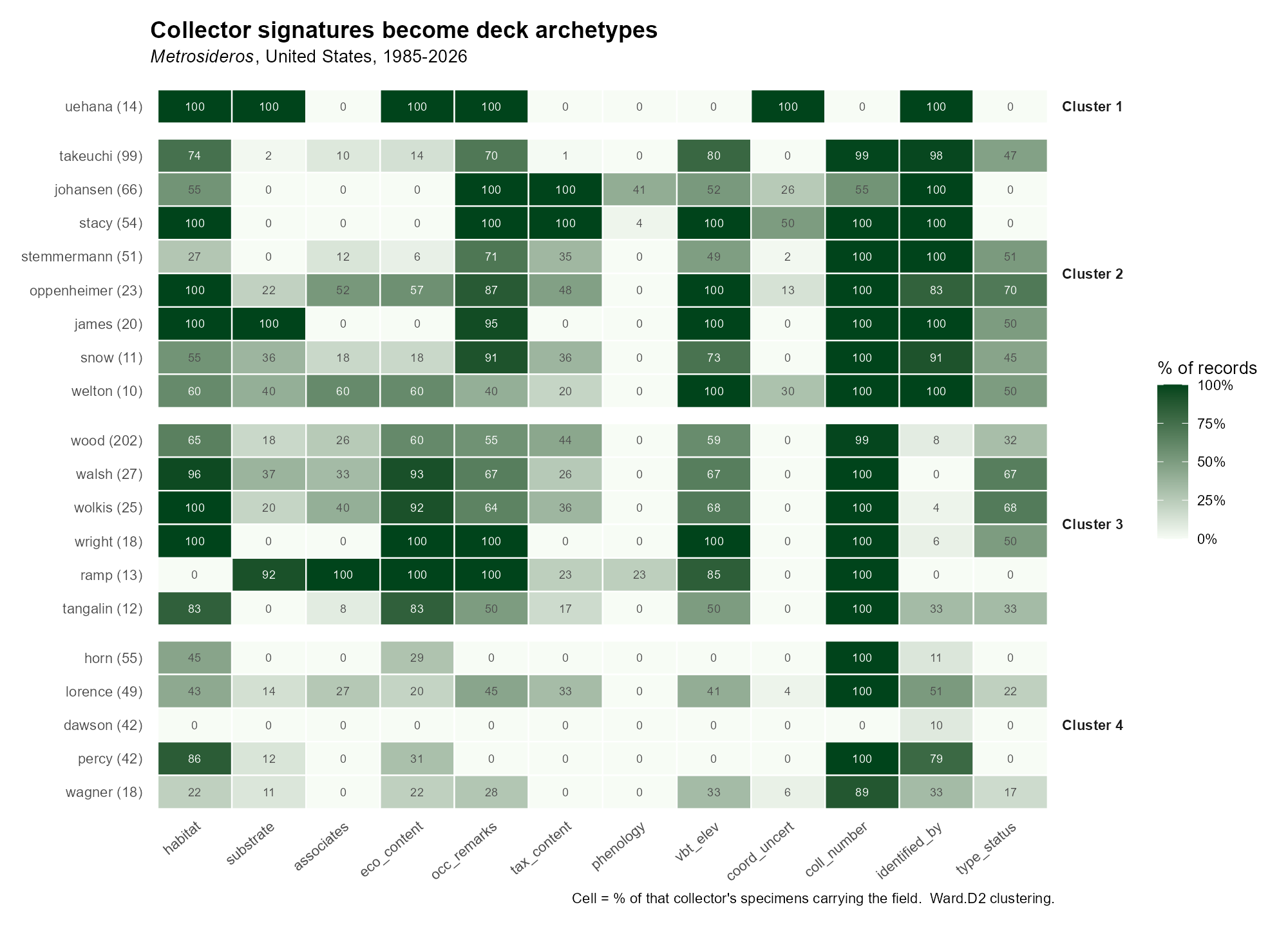
discover_decks() over 1,144 preserved-specimen records pulled from the aggregated Darwin Core corpus for the United States, 1985 to 2026, keeping collectors with ten or more specimens.
Read the figure a moment before the words. The bottom group is nearly empty, which is terseness made visible. Above it, a group that fills the determination column almost solidly. Above that, a group that fills the habitat and ecological-notes columns instead and leaves determination near zero, because those collectors name their own plants. And the single row at the top is filled to exactly 100 percent or exactly zero, all the way across.
Run this on the ʻōhiʻa records and four kinds of collector fall out of the data on their own. There are the describers, who note the parts of the flower and the plant’s stature and send it on to a specialist. There are the place-recorders, who note the habitat and the substrate and what grew alongside. There are the terse, who note little beyond the name and the spot. And there is the machine, a survey program filling every field to a template. Four working styles, none of them named in advance, all of them read out of the record. And one thing is missing from nearly every collector of every kind: phenology, whether the plant was flowering or fruiting, is hardly ever recorded. A gap that universal is not a discipline’s deck. It’s everyone’s.
Point the same method at a different plant and it answers differently, which is how you know it’s a method and not a lucky guess. Run it on kudzu, an invasive weed rather than a native tree, and the describers vanish, because nobody keys out a weed everyone can name. A new group appears, the mappers and monitors who record precise coordinates to track a spreading invasion. Phenology, near-absent for ʻōhiʻa, is recorded here, because with a plant you are trying to manage, its flowering matters. Different community, different record, different decks. The method does not hand back one answer. It hands back your community’s answer.
That is the whole point, and it is the path the deck chapter promised rather than the destination it withheld. The decks are not prescribed once and printed forever. They are discovered, from the record, for a particular flora and a particular time, and rediscovered when the field moves on. Give this to a botanist working a flora I have never seen, and she can find the decks her own work needs, out of her own community’s record, without asking me or anyone. Deck design stops being a matter of opinion and becomes a matter of measurement.
We now hold both halves of the record. The observed half is carried on decks a field can discover for itself. The fixed half is derived from the coordinate pair. All that remains is to watch the whole thing run, from a single photograph of a handful of cards to a finished label and a line in the log.