4 The Decks
We left the record built but half-empty. The fixed half, the elevation and slope and place, is waiting to be filled in from the coordinate pair. The other half, the things you judged standing at the plant, is what the cards carry, and the cards come in decks. A deck is nothing more than a small stack of cards for one kind of observation. My phenology deck is a card for a plant in heavy flower, a card for one in scattered flower, and a card for one carrying no flowers at all. You carry the deck, you lay down the card that fits, and the judgment is recorded. A deck is a question, and its cards are the answers you’re allowed to give.
Not everything you might write about a plant earns a deck, and knowing what doesn’t is half the design. A field earns a deck only if it passes three tests at once. It has to be something you observe, not something the landscape already fixes. It has to be categorical, a small closed set of choices, not a measurement or a sentence. And it has to be decided in the field, in front of the plant, not later at the desk. Run the tests and most of a traditional label falls away. The date and the coordinates come from the photograph, so they fail the first test. The elevation and the slope are fixed by the place, so they fail it too, and we’ll derive them. The family and the final determination are desk work, so they fail the third — though who will make that determination is settled before you ever leave the house, and that turns out to be worth a card, for reasons I’ll come to. The loose description of the habitat is a sentence, not a category, so it fails the second, and it has a home of its own we’ll come to. What’s left, after the filter, is a short list. The filter is the design; the decks are what survive it.
The cards you carry sort into four kinds, each with a different job. There are identity cards, the collection number first of all, and, when you already know what you’re after, a card for the target species. There are attribution cards, naming who collected the specimen and who determined it. Those look like observations and aren’t, and the difference is worth holding onto: an observation is what you saw standing in front of the plant, while a determination is a claim about who is answerable for the name. It carries an authority, and a later worker can revise it without disturbing a single thing you recorded in the field. Photographing who will do the determining does two jobs at once: it assigns the responsibility while the collection is being made, rather than leaving it to be remembered, and it means the field is already filled when the records are assembled, so nobody types it a hundred times. Attribution cards behave differently in the hand, too, because their value doesn’t change from plant to plant. You set them once in the morning and photograph the same card beside every specimen all day. There are observation cards, the categorical judgments the filter let through, the life form, the phenology, the abundance, and their like. And there is the comment card, a blank you write on, the one place the system lets you say anything at all. No set of decks will ever anticipate everything a plant or a place can show you, and the comment card is the honest admission of that. You reach for it rarely, and you’re glad it’s there when you do.
Here’s a thing about decks that matters the moment you leave home. A deck has two layers. There’s the facet, the question it asks, and there’s the value-set, the particular answers printed on its cards. The facet travels. “What is the substrate?” is a sensible question on any continent. The values don’t travel. The substrate cards I would print for Hawaii, lava and ash and cinder, are useless in Georgia, which wants clay and alluvium and roadside fill. So a deck built for one flora shares its facets with a deck built for another, and differs in its cards. You inherit the questions. You write the answers for where you work.
The decks are physical objects, and their form is made to match what they mean. An observation deck is a short stack of cards spindled on a screw post through a punched hole, between two stiff colored covers, front and back, so you find the deck by color before you read a word. Mine run yellow for phenology, gray for abundance, pink for life form, teal for the collectors and purple for the determination. That is one collector’s set of choices and not a standard; you should expect to make your own, and the only thing that matters is that you can tell them apart at arm’s length in bad light. You rotate one card into view and photograph it. That the deck can only show one card at a time is not a limitation, it’s the point: a plant is flowering or it isn’t, and the deck won’t let you claim both. The identity and comment cards ride in a business-card holder instead, because those you detach or write on. The whole kit fits in a vest pocket. The shape of the tool says how the tool is used.
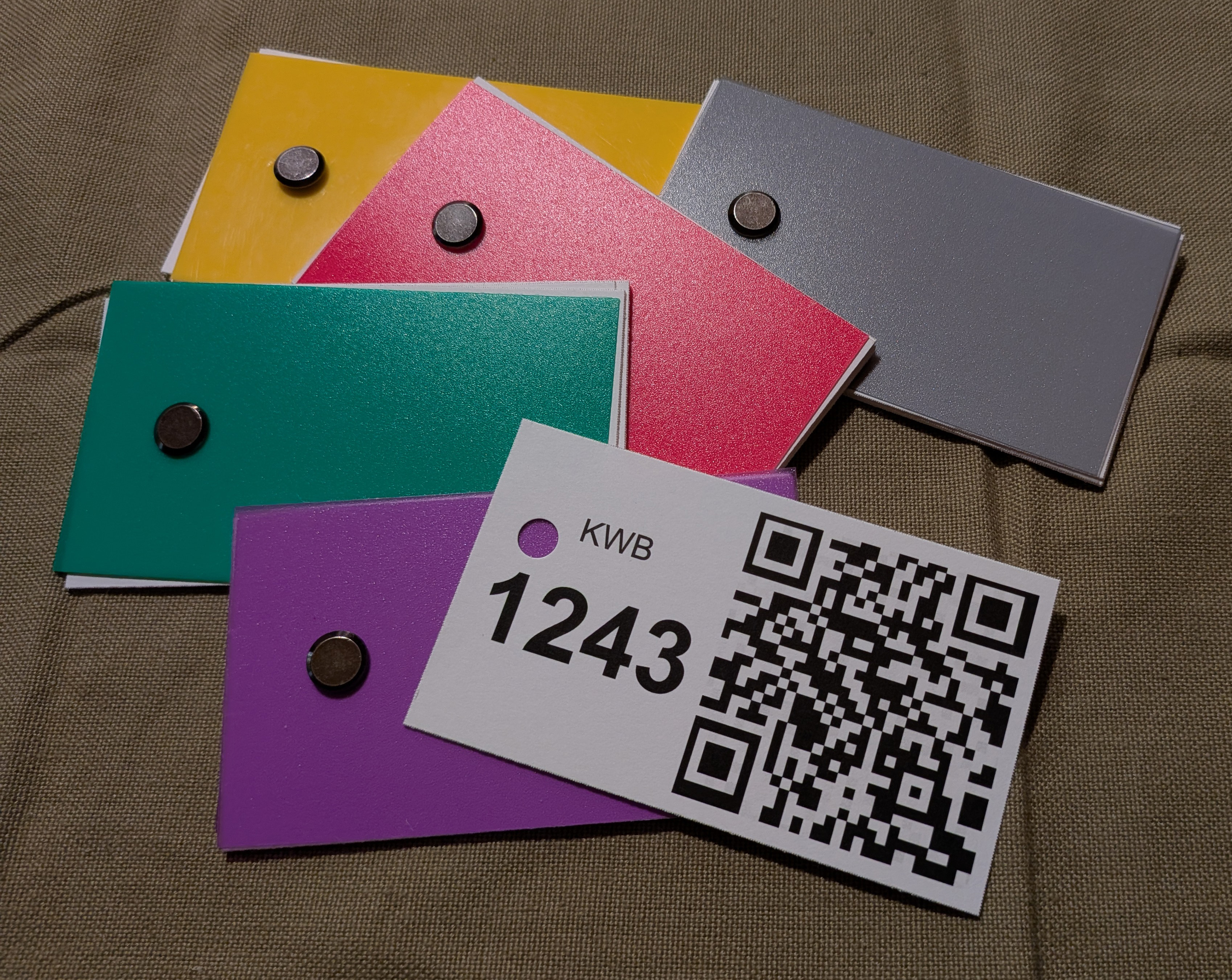
Two more small pieces of the deck are worth a sentence, because both were put there for a reason. Just inside each cover sits a blank card. It takes the handling the outermost printed card would otherwise take, and it does a second job that only shows up in the photograph: cover stock is not always as opaque as it looks, and a code read faintly through a cover is a value you never chose, arriving in the record as though you had. Every other worry about this system is about losing a reading. That one is about gaining a false one, which is worse, because a lost reading announces itself and a false one doesn’t. A blank card costs nothing and closes it.
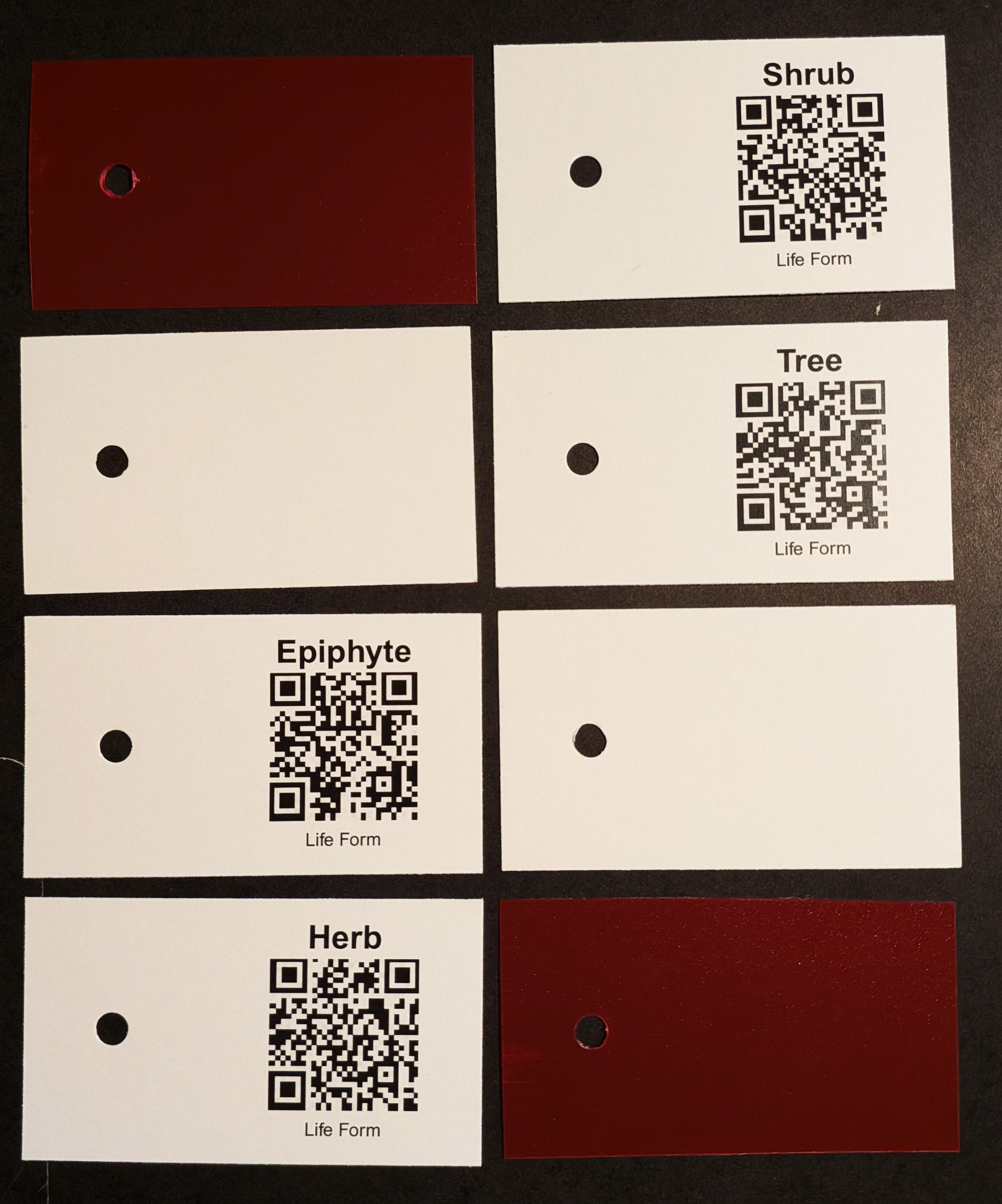
And the shape of the tool reaches further back into the design than I expected, which I found out by printing a deck that didn’t work. Laying out a card is a matter of plain geometry. You have three and a half inches by two, you center the value and the code and the field name in it, and the sheet comes off the printer looking exactly right. Assemble those same cards into a deck and the geometry is wrong. The post is at one end, the cards fan around it, and the stack lying over the card you’ve rotated out covers the better part of two inches of it. A code centered on the card falls inside that shadow, half buried, and will not read. Nothing was wrong with the layout considered as a layout. What was wrong is that it had been designed for a card, and a card in this system is never used as a card. It is used as one leaf of a bound object that hides its own bound end.
So the binding isn’t a container the design sits inside. It’s a fact the design has to answer to, and the answer is to concede the space the binding was going to take anyway: reserve a band along the bound edge, print nothing in it, and fit the value, the code and the field name into what’s left. The card gets narrower and the code gets smaller, and that is a real cost, paid for a code that can be read with the deck in your hand. It is worth saying how little room there is to spare. Measured on the assembled deck below, the cover reaches an inch and eight tenths across a three-and-a-half-inch card, and the code begins an eighth of an inch past it. That reserve is not a generous allowance. It is the whole difference between a deck that works and a deck that photographs beautifully and decodes to nothing.
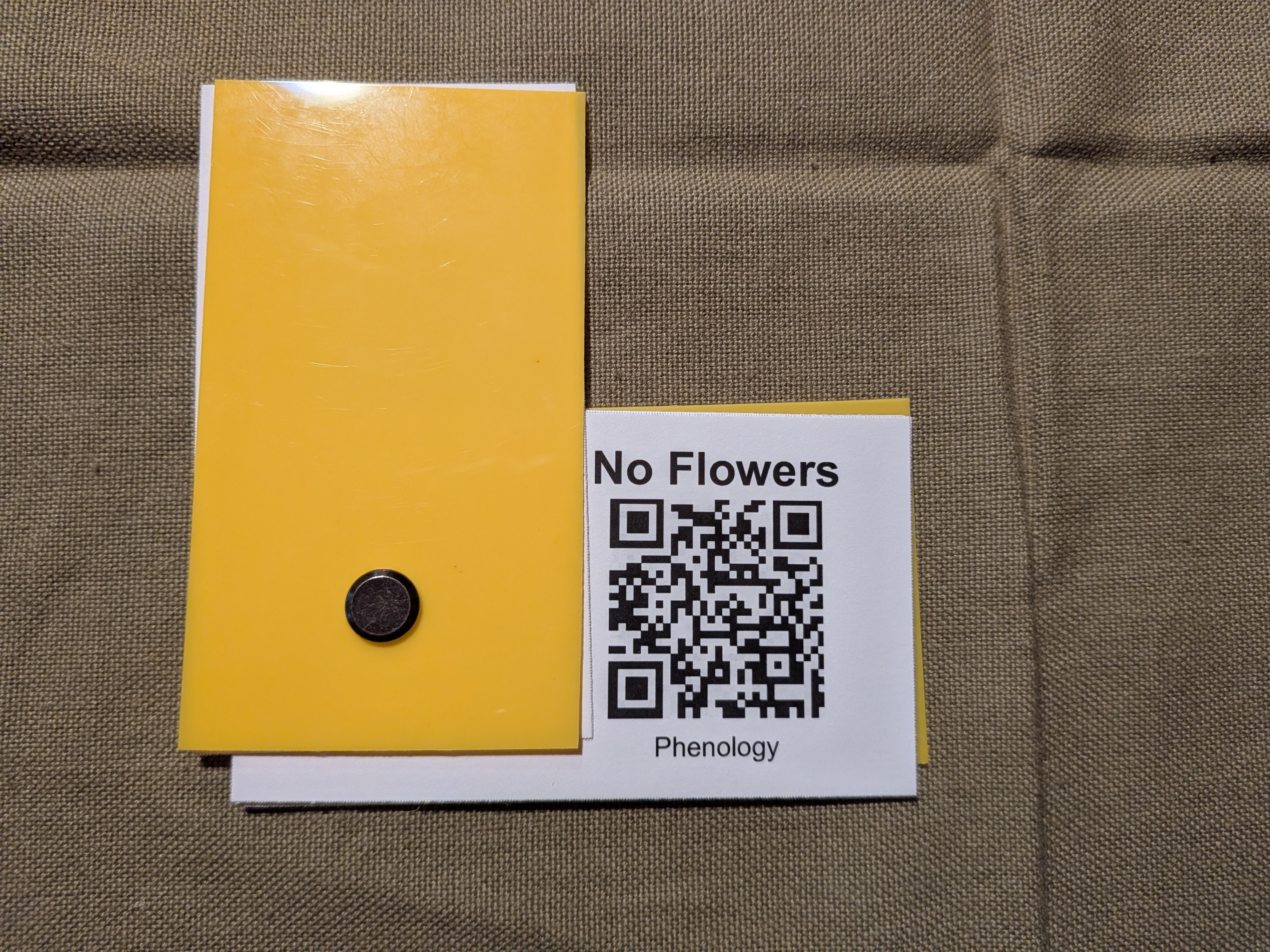
Phenology: No Flowers — the same image is the proof of clearance and the proof of content. (Photograph: K. Bridges)
There’s a general lesson in that, and it isn’t about cards. A layout drawn for an object in isolation can be exactly correct and still fail the moment the object is put to use, because use adds constraints the drawing never saw. The binding was invisible in the design file and decisive in the hand. It’s the sort of thing you find only by making the thing and using it, which is an argument for building a rough deck early rather than perfecting one on screen.
Two things make a deck better than a good memory and a pen. The first is the lesson of every serious checklist, in surgery and in aviation: under fatigue and pressure the trained mind quietly drops the obvious, and a list in the hand forces the essential few back into view. Tired, hungry, and rained on, you forget to note the very thing you would have called unmissable that morning, and the deck remembers for you. The second is quieter. Asked to name a plant’s habit from memory, the mind fixates, it snags on one vivid case and wanders off. Handed a small set of choices, it just picks. Recognizing the right answer is easier and surer than dredging it up. A deck guards what you would forget, and it spares you what you would rather not have to recall.
You’ll have noticed I haven’t given you the decks. I’ve given you what a deck is, how to tell what earns one, how the cards are shaped, and why they work, but not a set to print and carry. That’s deliberate. There isn’t one right set. A systematist and an ecologist want different cards, a rainforest and a roadside want different cards, and the decks that suited collecting fifty years ago aren’t the ones that suit it now. Handing you my decks would be handing you a destination. The path is worth more: a way to find the decks your own work needs. That way exists, and it reads its answer out of the accumulated record of your field: the answer is already in the cabinets. It belongs to the chapter after next. First there is the other half of the record to account for, the half the filter set aside as fixed by the place. That half we don’t card. We derive it.