1 These are small cars!
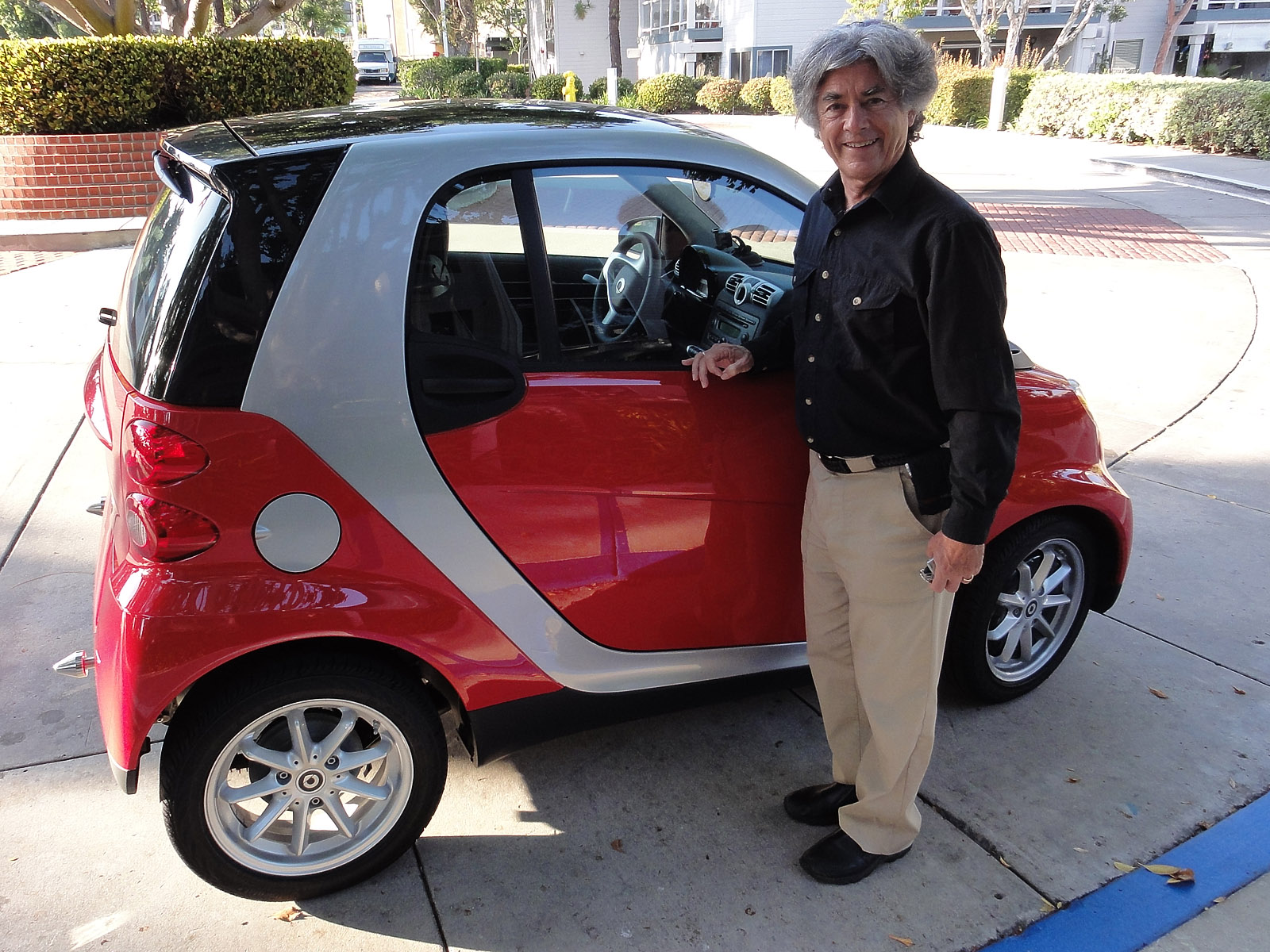
That’s the reaction, and it’s usually delivered as an exclamation rather than a question.
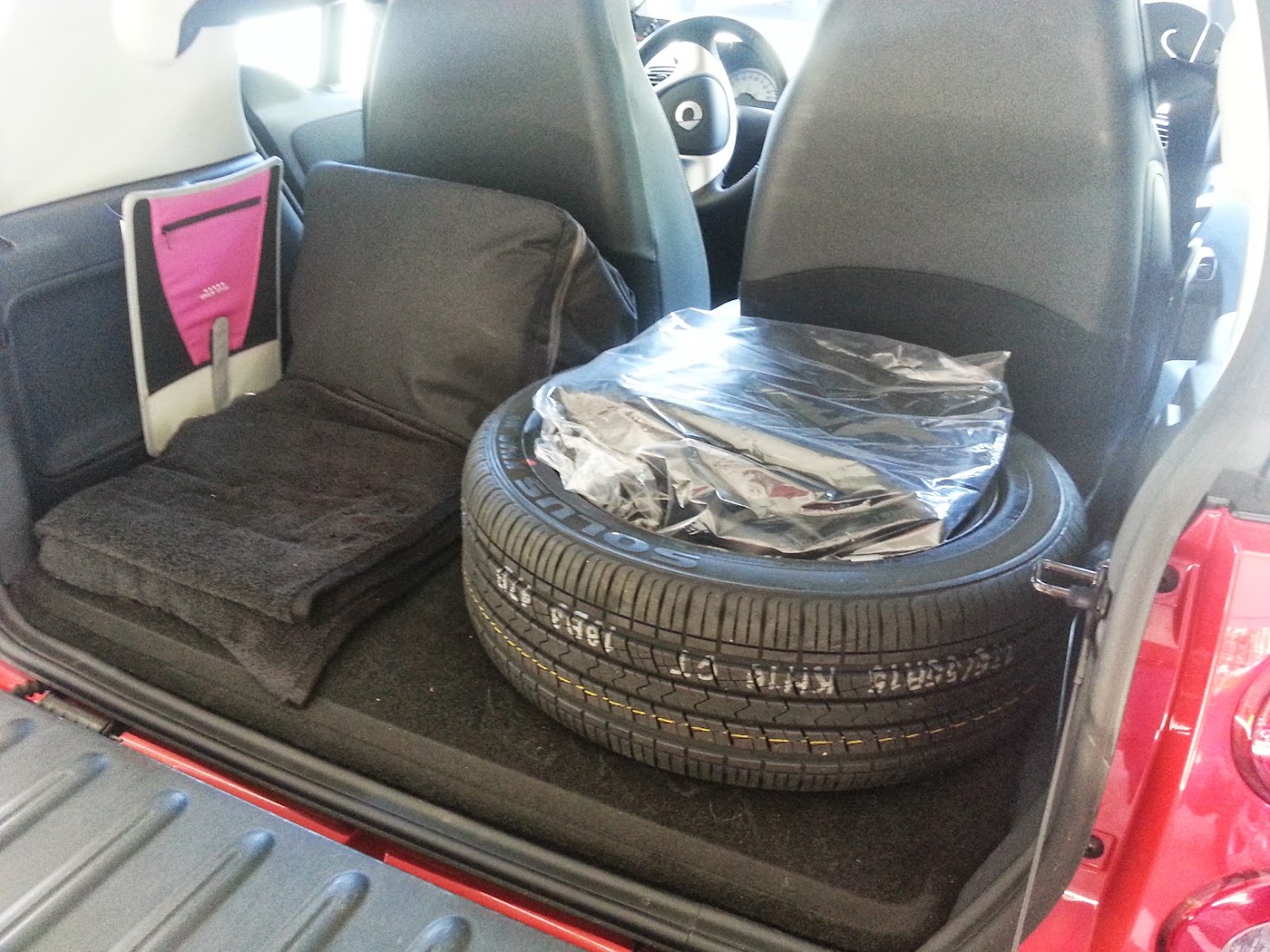
It’s worth being concrete about how small, because the rest of this book doesn’t make much sense otherwise. Two seats, and no back seat at all. Not a small one. None. The luggage space behind them is about the size of the trunk of an ordinary car with the trunk floor raised to the window line. And it sits on top of the engine. To load it you swing the rear window up and drop the tailgate down, which opens the whole back of the car.
I went out with a tape rather than look it up: 41 inches wide, 27 inches high, 24 inches deep. That last one is measured back to the driver’s seat in the position I actually drive in, which is the only depth that means anything when you’re loading.
I could multiply those together and give you a volume. It would be a useless number. Fill the compartment and you can’t see out of the back of the car. So the limit was never how much will go in. It is how much will go in and still leave the mirror working.
Before heading to Alaska I bought a spare wheel to carry, and it barely fit.
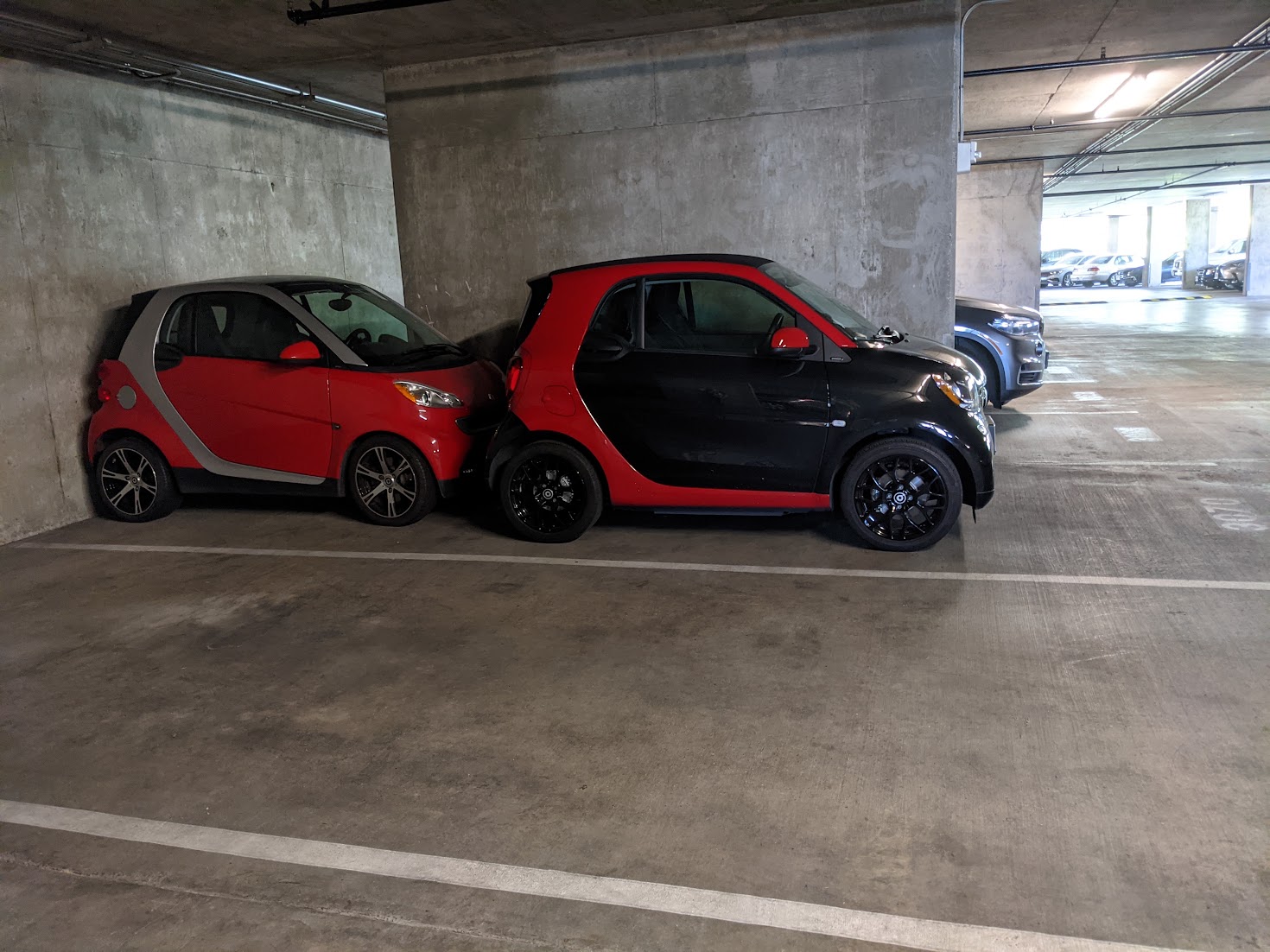
Here’s the other measure, and it’s the one I can point at today. TwoRed and Bordeaux both live in our building’s parking structure in Honolulu. We park them side by side. Nose to nose, they would fit inside a single space marked out for one ordinary car, with room to spare. When Matson shipped TwoRed they measured it for stowage, the way you measure any piece of freight: 8 ft 10 in long, 5 ft 1 in wide, 5 ft 0 in tall, 1,808 pounds. Two of them end to end come to 17 ft 8 in, which is why the pair fits where one ordinary car is meant to go.
The owner’s manual gives a different width: 69.0 in, against Matson’s 61 in. Neither is wrong. The gap is 8 in. That’s 4 in a side. The manual settles it in a footnote: that width is measured with the mirrors folded out. The manual is describing the car you drive, mirrors and all; the shipping clerk measured the car you stow. Length and height agree between them to within a rounding tick. Which width you want depends on whether you are parking it or putting it on a boat, and that is going to keep happening in this book.
1.1 It isn’t a shrunken car. It’s a car built around a box.
Most small cars are ordinary cars made smaller. A Smart isn’t. Mercedes started from the steel cell you can see in Figure 1.1, the silver band, and built outward. The cell is the structure. The colored panels hung on it aren’t. That’s why the proportions look wrong to an eye trained on normal cars: you’re looking at a passenger box with the mechanical parts pushed to the ends, rather than a long car with the middle removed. The manual puts a number on it. The wheelbase is 69% of the total length, which leaves about 16 in of car hanging past each axle. There is almost nothing at the ends because there is almost no end.
It’s also why the panels are a different color. They aren’t pretending to be structural, so they don’t have to match.
1.2 What it was designed to be good at
A Smart is boxy. It pushes the wind rather than slipping through it, and no amount of small engine makes up for that at seventy miles an hour. I knew that when I bought TwoRed. I’d get economy, because it’s a small car with a small engine. But highway economy was never what the thing was built for.
What it was built for is a short list, and the car is very good at all of it. Safety, which is the next chapter and the reason the steel cell is the first thing you see. Fitting into spaces other cars can’t use. Carrying a surprising amount of gear in the box behind the seats.
Notice what isn’t on that list. Then notice that we bought it anyway, and drove it across the continent four times.
Every fuel figure in this book is a number produced by a car that was optimized for something else. It is a good deal better than it has any right to be, and that is worth holding onto before any of those numbers start looking like an achievement of engineering rather than an accident of small size.
1.3 Why a Smart, and not something else
There were other small cars in 2010. The honest answer for why it was this one is that the decision was partly emotional, and I don’t mind saying so.
We’d seen them all over Europe, and people were having fun with them. That is not a specification, but it is a real reason, and it got there first.
The rest of it was ordinary enough. The price was right. And there was the ecological-economy side of it. We simply didn’t see the need for a large car. Two people who travel light, going a long way, do not require much car to do it in.
There were a few alternatives. None of them hit all of those at once the way a Smart did.
1.4 You sit high, which nobody expects
Getting in is unremarkable. It’s about like getting into any sedan. You fit, but you watch your head going in. Then you sit down and the car surprises you.
You sit high. Almost like getting into an SUV. You’re not down near the road the way the outside of the car leads you to expect.
That follows directly from the box. A car built around a passenger cell puts you in the cell, upright, rather than reclining you into a wedge. Which is also why a Smart isn’t streamlined. Across the body it is very nearly as tall as it is wide. It’s 5 ft 0 in against 5 ft 1 in, by the carrier’s own tape. That is not a shape chosen for slipping through air. It’s a shape chosen for putting a person upright inside it.
The payoff is headroom, and there’s a lot of it. I’m five foot seven, which is to say I stand taller than the car does, and I’ve never come close to the roof. I’ve had big friends fold themselves in expecting the worst, and had no complaints afterwards.
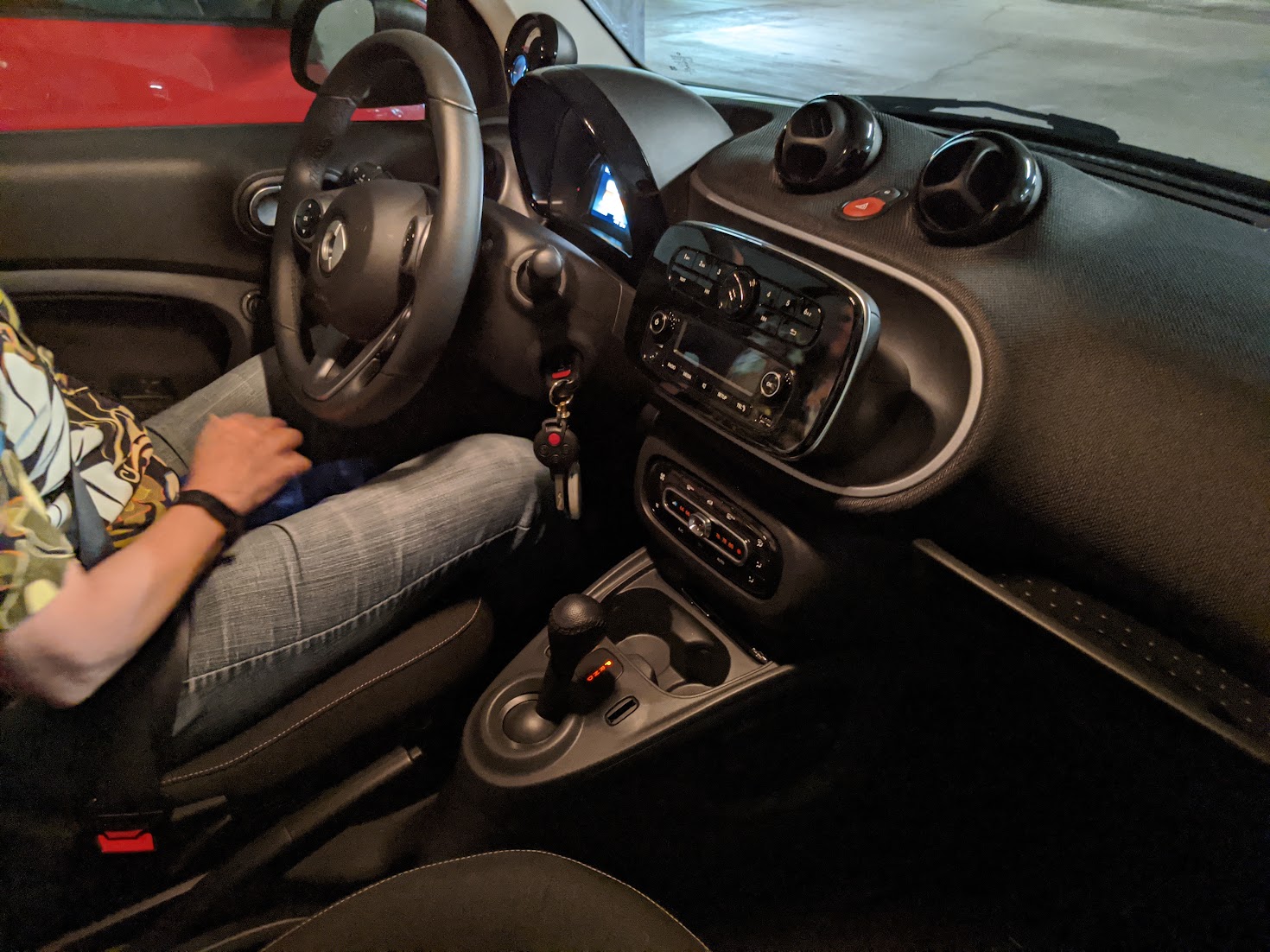
There’s one more thing about sitting in a box, and it only shows up on a long day. Behind the seats there’s a shelf, and you can reach it without stopping. Snacks. A jacket. The camera. That’s a genuinely useful travel feature and no one ever mentions it in a review.
1.5 The Costco test
The other thing people assume is that there is nowhere to put anything.
The space behind the seats, as I said, is an ordinary trunk stood on end. We travel light, so we rarely fill it, unless we are ferrying something large for somebody.
Around town the test is Costco. I don’t hesitate over the big awkward things. The bundle of toilet paper. The bundle of paper towels. Both in the same trip, if that is the week. All of that on top of the ordinary shopping. It goes in. And I can still see out the back window when I look in the mirror.
In sixteen years I have never once put something back on the shelf because I was afraid it wouldn’t fit in the car.
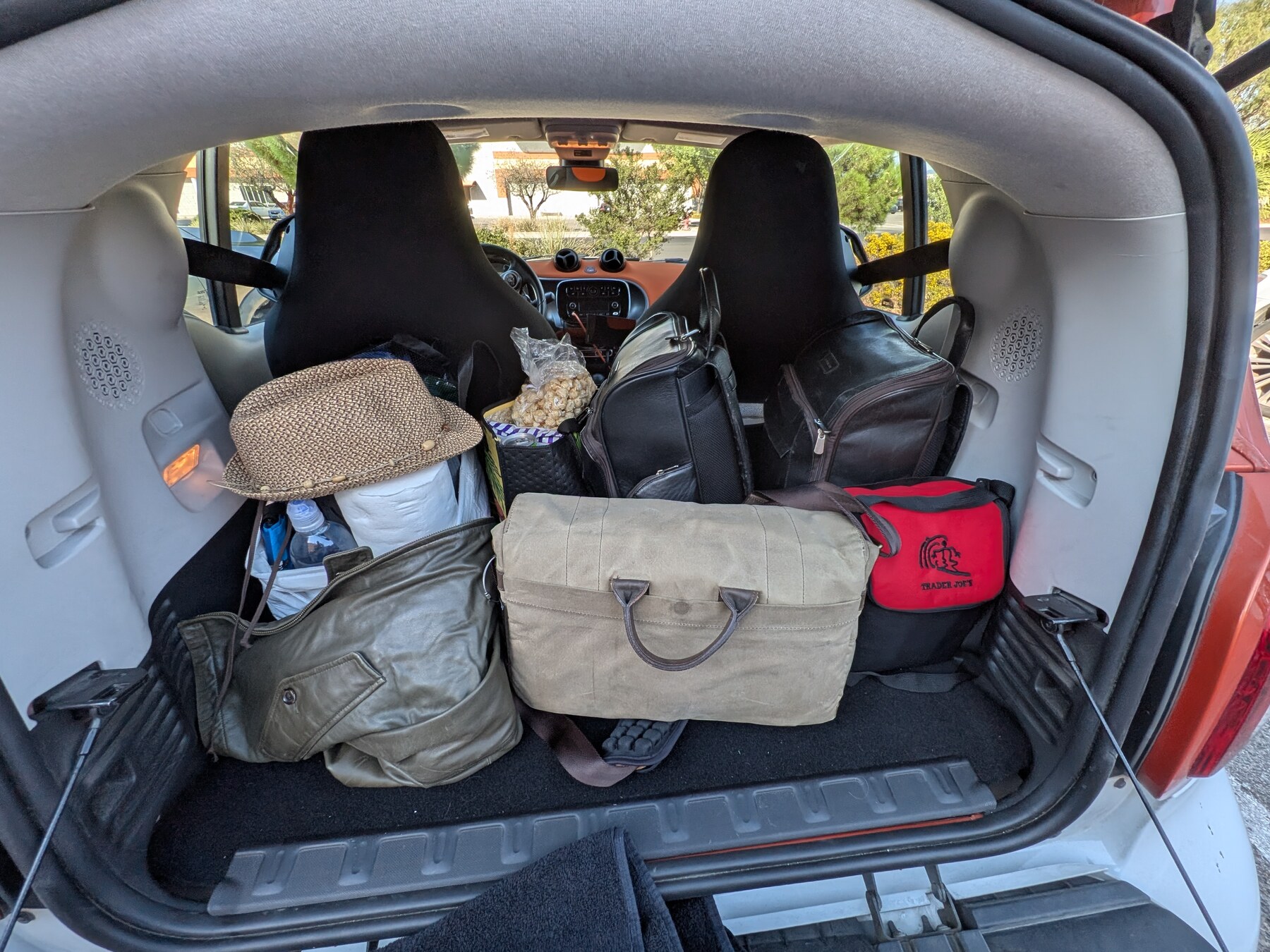
The limit isn’t cargo. It’s seats. There are two, and most people say yikes when they work that out.
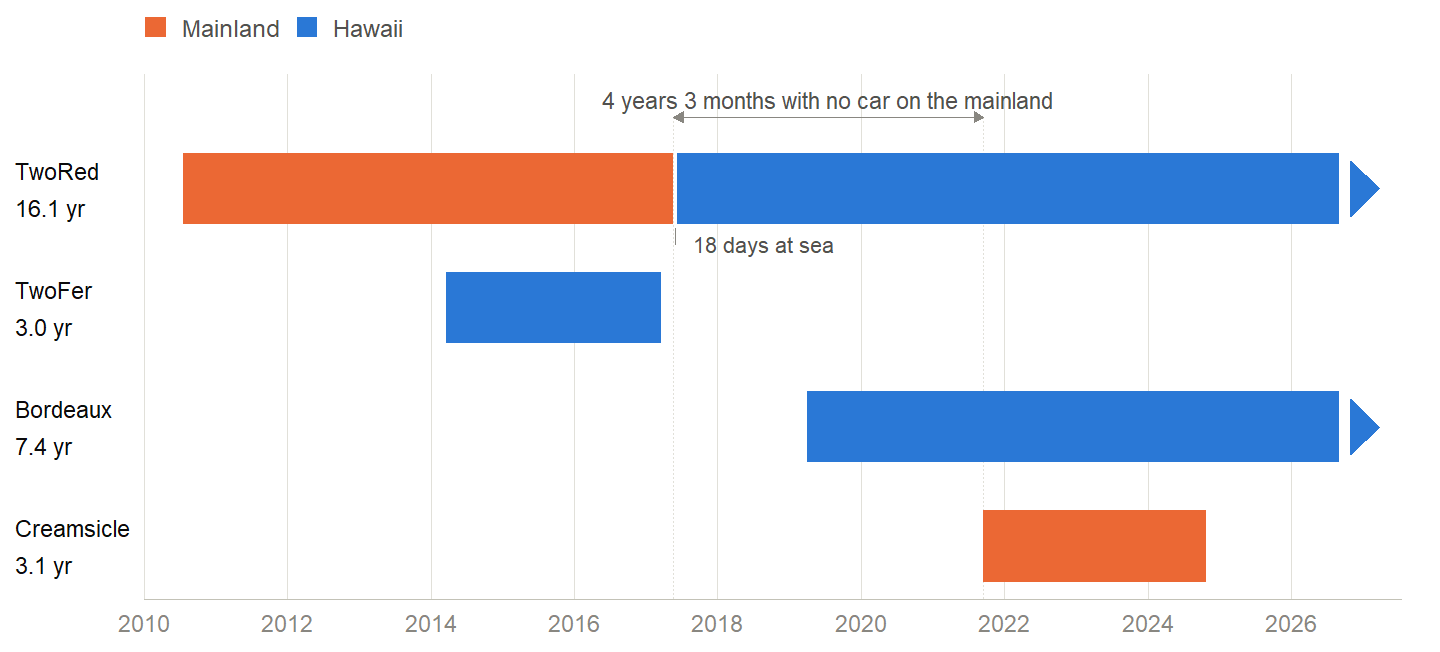
My answer is that I’d have exactly the same problem in a Lamborghini. And I can carry things the Lamborghini can’t. When we need to move four people, we take both cars. Two cars, two passengers. That’s not a workaround we invented; it is why two of the bars in Figure 1.8 run side by side from 2019 on.
1.6 The transmission, which I will not defend
TwoRed has one honest weak point and it’s the automated manual transmission. In town it isn’t as smooth as I’d like. That’s the complaint, and it’s a fair one.
On the highway it stops mattering, because once you’re up to speed there’s almost no shifting to do. Creamsicle, six model years later, had a much better transmission, and local driving was noticeably nicer for it.
Here’s the part I didn’t expect. The record cannot referee any of this. Not one of TwoRed’s 293 usable legs is shorter than 100 miles, and Creamsicle’s shortest is 70. There’s no town driving in the fuel log at all.
The reason is that a leg isn’t a trip. It’s a tankful, and neither car holds much. The largest single fill anywhere in sixteen years of TwoRed’s record is 8.7 gallons. Errands don’t go missing from the record so much as get absorbed into it: a week of short runs and then a long highway day arrive at the pump as a single leg with a single number. The instrument has a resolution, and the tank sets it.
So the transmission complaint is about driving that sixteen years of careful record-keeping never once saw. We will come back to that.
1.7 A table at my right hand
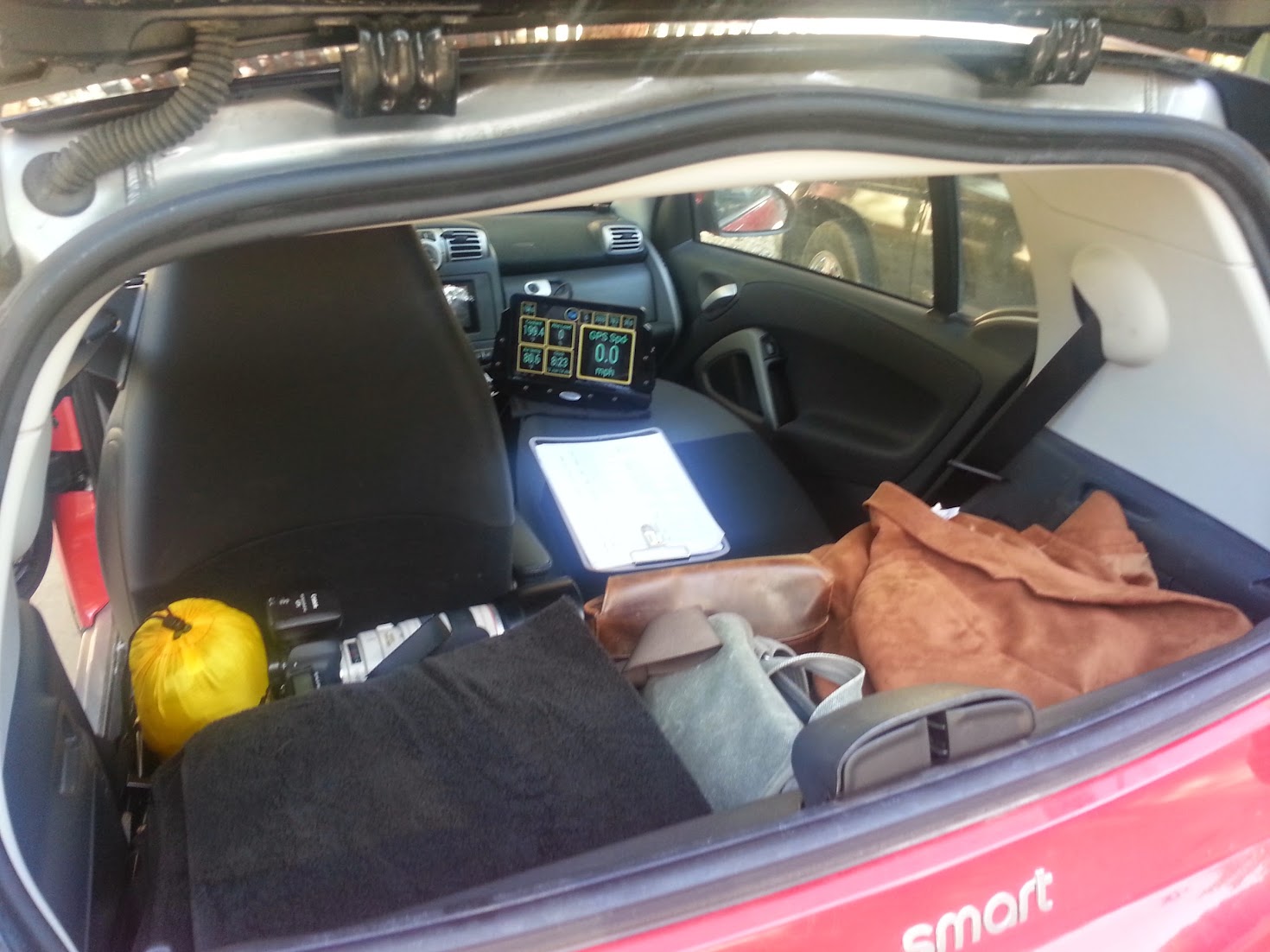
On the solo long-distance drives I generally put the passenger seat down flat. That gave me a table off to my right. The thing that lived on it was the clipboard with the travel information.
Which is worth saying plainly, because the rest of this book depends on it. The record exists because the car had a flat surface within arm’s reach.
1.8 What everyone assumes it’s for
People assume a car this size is for short trips in a crowded place. That’s a fair assumption. It’s what Mercedes designed it for, and it’s what most of them do.
And we owned one that did exactly that.
Two4Two, which we called TwoFer, was leased in Honolulu in March 2014 and never left the island. It was a stand-in: something to drive at home until we could bring TwoRed across. Only short trips, and we kept no proper logs for it.
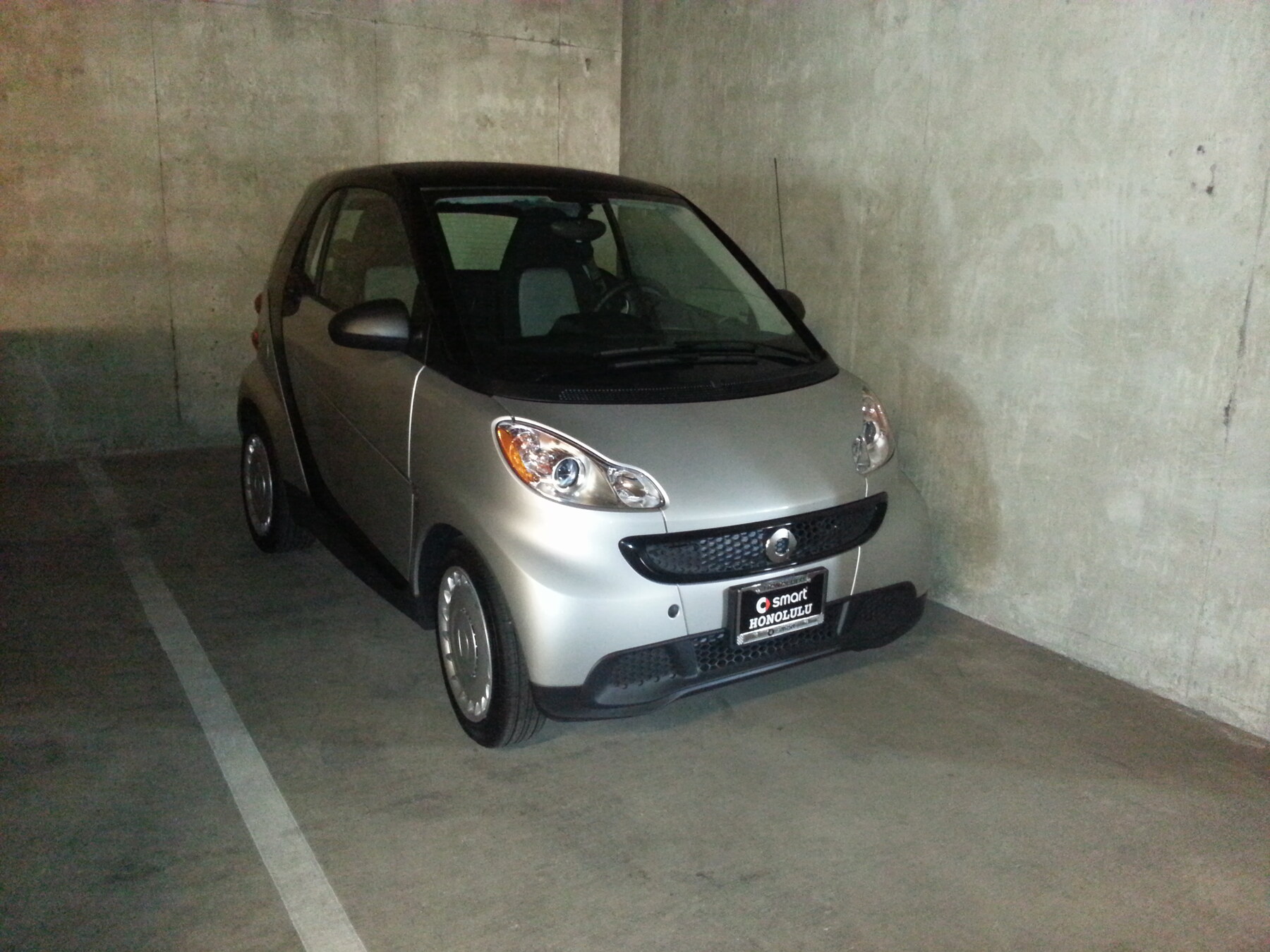
The lease ran thirty-six months and ended on March 22, 2017. TwoRed was handed to a shipping company in Seattle sixty-one days later. The stand-in went back two months before the car it stood in for arrived.
The record is seven fill-ups, between March 2014 and January 2015. They cover 1,209 miles. The lease allowed 22,500 over its whole term and the closing statement charged nothing for mileage at all, so whatever TwoFer did in three years, it wasn’t much.
TwoRed’s median driving day, on the mainland, was 305 miles.
So TwoRed covered TwoFer’s entire logged mileage in about four days of driving. Same manufacturer, near enough the same car, and the difference isn’t in the machine at all. It’s in what we asked of it.
1.9 Four cars, and not the sequence you’d guess
The Foreword introduced them. What matters here is the shape, and it isn’t a relay.
TwoRed, July 23, 2010. Bought new in San Diego with four miles on the odometer. We still have it. It has never been replaced. That’s the thing to hold on to, because the other three all arrived around it rather than after it.
TwoFer, March 2014 to March 2017. A three-year lease, in Honolulu, entirely inside TwoRed’s life. A stand-in, not a successor.
Bordeaux, April 1, 2019. Leased first, then bought out at the end. Mercedes insisted on that procedure, presumably for reasons of their own. It was ours from the first day of the lease and it still is.
Creamsicle, September 15, 2021. Bought used. A 2016 car, five years old. Sold to family in October 2024.
★ And there’s a hole in the middle of that list. TwoRed left the mainland in May 2017. Creamsicle wasn’t bought until September 2021. For four years and four months we had no car on the mainland at all, and the long drives simply stopped.
So Creamsicle isn’t TwoRed’s replacement. It’s the resumption. Mainland driving picked up again after a four-year pause, starting from a different part of the country because the parking space that had organized everything was gone.
That’s the fleet argument, and it doesn’t depend on any single car being good. One car you like is taste. Four, chosen and re-chosen across sixteen years, is a judgment. One bought used. One leased twice over. One still sitting in the garage.
1.10 Which brings us to the question
People who see the car say they like it. Then, almost always, they ask whether it’s safe.
I have an answer. It involves Mercedes, and that steel cell, and a comparison to race cars, and I’ve given it many times standing next to the car with my hand on the silver part.
Do they believe it? Maybe. Maybe not.
That’s the honest report, and it’s why the next chapter doesn’t stop at the engineering.