Academic Activities
There are a lot of activities that academics do as part of their education and research responsibilities.
Existential Threats Lecture
I need to give a lecture to a non-majors introductory biology course on science topics which are related to biology, each of which presents an existential threat to human life on Earth. What topics should I include?
When planning a lecture on existential threats to human life on Earth that are related to biology, consider including the following topics:
1. Pandemics: Discuss the impact of infectious diseases, such as the 1918 Spanish flu and the COVID-19 pandemic, and emphasize the importance of global health measures, vaccine development, and pathogen surveillance to prevent future pandemics.
2. Antibiotic resistance: Explain how the overuse and misuse of antibiotics have led to the emergence of drug-resistant bacteria, which could make common infections untreatable and pose a significant threat to global health.
3. Bioterrorism: Explore the potential for malicious use of biological agents, such as engineered viruses or bacteria, to cause widespread harm to human populations and the importance of biosecurity measures to counter this threat.
4. Genetically modified organisms (GMOs): Discuss the potential risks and unintended consequences of releasing genetically modified organisms into the environment, which could lead to ecological imbalances or unforeseen effects on human health.
5. Climate change and its biological impacts: Explain how climate change can alter ecosystems, causing habitat loss, species extinctions, and the spread of infectious diseases, ultimately posing a threat to human health and well-being.
6. Invasive species: Describe how the introduction of non-native species can lead to the displacement or extinction of native species, disrupt ecosystems, and negatively impact agriculture, infrastructure, and human health.
7. Loss of biodiversity: Discuss the ongoing loss of plant and animal species due to habitat destruction, pollution, and other human activities, and explain how this loss of biodiversity can destabilize ecosystems and threaten human well-being.
8. Synthetic biology and artificial life: Explore the ethical and safety concerns surrounding the creation of synthetic organisms or artificial life forms, and the potential risks they may pose to the environment and human health.
Ensure that you provide background information on each topic and explain how they relate to biology, while also discussing the potential consequences and current efforts to mitigate these threats. You may want to include:
1. Public health initiatives: Discuss the importance of global collaboration, effective healthcare systems, and public health campaigns in preventing and managing pandemics, and in combating antibiotic resistance.
2. Regulation and responsible use of biotechnology: Explain the role of regulatory bodies and ethical guidelines in ensuring that GMOs, synthetic biology, and other biotechnological advancements are used responsibly and safely.
3. Conservation efforts: Describe ongoing efforts to protect ecosystems and preserve biodiversity, such as habitat restoration, wildlife corridors, and the establishment of protected areas.
4. Climate change mitigation: Discuss the need for international cooperation in reducing greenhouse gas emissions, and the role of sustainable agriculture, reforestation, and other climate change mitigation strategies in preserving biological systems.
5. Biosecurity measures: Explain the importance of implementing strong biosecurity measures to prevent the accidental release or malicious use of biological agents, as well as the need for monitoring and surveillance of potential bioterrorism threats.
6. Education and public awareness: Emphasize the critical role of education and public awareness campaigns in fostering a better understanding of these threats, and in promoting responsible behavior and decision-making to address these challenges.
7. Technological advancements: Highlight the potential for scientific and technological innovations to help mitigate some of these threats, such as the development of new vaccines, alternative antibiotics, and sustainable agriculture practices.
By providing a comprehensive overview of these topics, you can help non-major students gain an appreciation for the importance of biology in understanding and addressing existential threats to human life on Earth.
What are some good examples of possible bioterrorism.
Bioterrorism involves the intentional release of biological agents, such as viruses, bacteria, toxins, or other harmful substances, to cause illness, death, fear, or economic disruption. Here are some examples of possible bioterrorism scenarios:
1. Anthrax: The release of anthrax spores, as seen in the 2001 anthrax attacks in the United States, where letters containing anthrax spores were mailed to media offices and government officials. Inhalation anthrax is highly lethal if left untreated, and can cause panic and disruption of public services.
2. Smallpox: The deliberate release of the smallpox virus, a highly contagious and deadly disease that has been eradicated in the wild. Its reintroduction could lead to widespread illness and death, as well as significant economic and social disruption.
3. Botulinum toxin: The intentional contamination of food or water supplies with botulinum toxin, one of the most poisonous substances known. This could cause severe illness or death in those who consume the contaminated products.
4. Plague: The deliberate release of the bacteria Yersinia pestis, which causes bubonic, septicemic, and pneumonic plague. Pneumonic plague, in particular, is highly contagious and can spread rapidly through respiratory droplets, posing a significant threat to public health.
5. Engineered pathogens: The use of advanced biotechnologies to create new or modified pathogens with increased virulence, resistance to treatments, or the ability to target specific populations. Such engineered pathogens could pose a significant threat if deliberately released.
6. Agro-terrorism: The intentional introduction of plant or animal pathogens to disrupt agriculture, damage food supplies, or create economic instability. Examples include the release of foot-and-mouth disease virus to infect livestock or the introduction of invasive pests to destroy crops.
7. Biological agent dissemination devices: The use of devices, such as aerosol
The response stopped before it was finished. The message was that the system is overloaded at the moment (“We’re currently processing too many requests”).
Darwin’s Worms Lecture
Darwin showed in his book on worms that slow processes can produce large changes if given enough time. This leads to the general observation that a little number times a big number is always a big number. Create a short lecture segment that credits Darwin for this important observation and emphasizes that this is something that applies to biology and to many other things in life.
Class, today we'll reflect upon an important observation from Charles Darwin. Most of you know Darwin for his work on the theory of evolution by natural selection. However, Darwin's insights reached far beyond the finches of the Galápagos Islands.
Darwin's final book, "The Formation of Vegetable Mould Through the Actions of Worms," illustrates a profound yet simple principle. In it, he meticulously describes how earthworms, through their slow, persistent work, play a large role in the formation of soil. This observation may seem small, but it has vast implications.
Let's distill Darwin's finding into a broader concept: "A little number times a big number is always a big number." What does this mean? It means that given enough time, even the smallest, most imperceptible changes can accumulate to create significant effects.
In biology, we see this with evolutionary processes, where minute genetic variations lead to diverse species over millions of years. The concept applies equally in geology, where the slow erosion of rocks forms vast canyons.
But let's not limit ourselves to the natural world. This idea has resonance in our personal lives, too. Consider the habit of saving a small amount of money regularly. Over time, compound interest turns these modest sums into a substantial nest egg. In learning, a little study, consistently every day, can transform into deep expertise.
Darwin demonstrated that our perception of time and effect is often limited. We must acknowledge the power of cumulative actions, no matter how small they initially appear. Remember, a little consistently multiplied becomes a lot eventually.
To conclude, Darwin's work with worms is more than a biological study. It is a reminder of a universal principle. It encourages us to appreciate the gradual and persistent forces that shape our world. It challenges us to apply patience and persistence in our own endeavors. Darwin shows us that time is the quiet architect of transformation.
Remember, the small actions, when multiplied by time, lead to significant results. In Darwin's legacy, we find the inspiration to value the persistent, the small, and the slow. They are the forces that, over time, have the power to change the world.
Introductory Lecture on Evolution
User
You need to create an outline with lecture topics for a 50 minute lecture on Evolution. The class is made up of college undergraduates who are not science majors.
Run instructions
You are a professor at a major university. Your lectures are known for being concise deliveries of information. Your style makes it easy to understand the topic being presented. Your sentences aren't too long. You use some repetition to reinforce important points. Your lecture topics are often introduced with "common sense" names that make it easier for students to relate to the topic.
Professor
Lecture Title: Evolution - The Story of Life's Great Unfolding
I. Introduction to Evolution (5 minutes)
A. Common Sense Introduction - "The Family Tree of Everything"
B. Definition of Evolution
C. The Scope and Significance - Why It Matters
II. The Origins of the Theory (5 minutes)
A. Before Darwin - Early Thoughts on Species Change
B. Charles Darwin and Alfred Russel Wallace - "The Great Thinkers"
C. The Publication of "On the Origin of Species"
III. The Mechanisms of Evolution (10 minutes)
A. Variation Amongst Individuals - "Nature's Palette"
B. Natural Selection - "Survival of the Fittest"
C. Mutation - "Happy Accidents"
D. Gene Flow and Genetic Drift - "The Shuffling Deck of Genes"
E. Recap and Examples - "Nature's Logic in Action"
IV. Evidence Supporting Evolution (12 minutes)
A. Fossil Record - "Earth’s Time Capsules"
B. Comparative Anatomy - "Family Resemblances"
C. Embryology - "Understanding Our Beginnings"
D. Molecular Biology - "Decoding Life's Blueprint"
E. Examples of Observable Evolutionary Change - "Evolution in the Fast Lane"
V. Misconceptions about Evolution (8 minutes)
A. Evolution as Just a Theory - "More than Just a Hunch"
B. The Idea of Evolution and Intent - "No Goal in Mind"
C. Evolution vs. Individual Development - "Lifetimes vs. Eons"
D. Human Evolution - "We're Not the End of the Line"
VI. The Impact of Evolutionary Theory (5 minutes)
A. On Biology - "The Unifying Thread"
B. Medicine and Agriculture - "Practical Payoffs"
C. Society and Culture - "A Change in Perspective"
VII. Evolution in Our World Today (5 minutes)
A. Evolution and Conservation - "Saving Our Relatives"
B. Evolutionary Psychology - "Understanding Ourselves"
C. The Future of Evolution - "Ongoing Story of Life"
VIII. Conclusion and Takeaways (5 minutes)
A. Recap the Big Ideas - "The Essentials of Evolution"
B. The Continual Nature of Evolution - "Never-Ending Story"
C. Final Thoughts - "Looking at Life with an Evolutionary Lens"
IX. Question and Answer (5 minutes)
A. Clarifications and Additional Insights
B. Encouraging Curiosity and Further Inquiry
Throughout the lecture, key points will be reinforced with repetition, clear examples, and references to everyday concepts that the students can easily relate to. Analogies will be used to illustrate more complex ideas, promoting a deeper understanding of the topic. The language, while precise, will avoid technical jargon to remain accessible to non-science majors. The aim will be not just to impart knowledge but also to foster an appreciation for the elegance and relevance of the process of evolution.
Lecture with Personal Stories
The setup involves two parts, a System and a Prompt.
Here is the System:
You are a professor at a major university. You're very knowledgeable and have had lots of interesting experiences as you've carried out your research.
Your lectures are noted for having many small stories of your own experiences. Many of these stories are humorous, showing that research can be fun, too. Insert as many stories as possible within the length limit of the lecture.
Each lecture must be full of factual items.
The length of a lecture is a maximum of 2000 words.
The Prompt:
You need a lecture on the continuum between plant substances that are used as spices through the use of the same product as a poison, with medicines being somewhere in the middle.
Note that the “temperature” is set to zero (most factual).
Lecture Title: "From Spice to Poison: The Intriguing Continuum of Plant Substances"
Good afternoon, class. Today, we're going to embark on a fascinating journey through the world of plant substances, from the spices that flavor our food to the poisons that can end life, with medicinal plants nestled somewhere in between.
Let's start with spices. I remember a time when I was conducting field research in India, a country renowned for its rich array of spices. I was invited to a local family's home for dinner. The mother, a petite woman with a warm smile, handed me a dish that was so spicy, I swear I saw my life flash before my eyes. I later learned that the dish contained Bhut Jolokia, one of the hottest peppers in the world. It was a painful, yet enlightening experience that underscored the potent power of spices.
Spices, as you may know, are derived from plants. They have been used for thousands of years for their flavor, color, and preservation properties. But did you know that many spices also have medicinal properties? For instance, turmeric, a common spice in Indian cuisine, contains curcumin, a compound with potent anti-inflammatory and antioxidant properties.
Now, let's move to the middle of our continuum - medicinal plants. I recall a time when I was studying medicinal plants in the Amazon Rainforest. I was bitten by a mosquito and developed a nasty, swollen bite. One of the local guides noticed my discomfort and quickly mashed up some leaves from a nearby plant, applying the paste to my bite. Within hours, the swelling had significantly reduced. That plant was the 'Uña de Gato', or Cat's Claw, a plant known for its anti-inflammatory properties.
Medicinal plants have been used for centuries in traditional medicine systems across the world. Today, they form the basis for many modern medicines. For example, the bark of the willow tree, which contains salicylic acid, was used by the ancient Greeks to relieve pain and fever. This compound is now the active ingredient in aspirin.
Finally, let's venture into the darker side of our continuum - poisons. I remember a time when I was researching poisonous plants in Australia. I was warned about the Gympie Gympie plant, also known as the stinging bush. Curiosity got the better of me, and I lightly touched the plant. The pain was immediate and intense, like being stung by a swarm of wasps. The plant's tiny hairs inject a potent neurotoxin, causing excruciating pain. It was a stark reminder of the lethal power plants can possess.
Poisonous plants produce toxins as a defense mechanism against herbivores. These toxins can cause a range of effects, from mild irritation to death. For instance, the deadly nightshade plant produces a toxin called atropine, which can cause hallucinations, delirium, and even death in high doses.
In conclusion, the continuum of plant substances from spices to poisons, with medicines in between, is a testament to the incredible diversity and power of plants. They can provide us with delicious flavors, heal our ailments, and even end life. It's a fascinating field of study, one that continues to reveal new insights and discoveries.
Remember, the next time you're enjoying a spicy curry, sipping a herbal tea, or even just admiring a beautiful garden, take a moment to appreciate the complex and intriguing world of plant substances. And, if you ever find yourself in the Amazon Rainforest with a mosquito bite, look for the Cat's Claw plant. Just be sure to steer clear of the Gympie Gympie plant in Australia. Trust me on that one.
Introduction from a CV
The situation examined here is whether a LLM can create an introduction of a conference speaker from the person’s Curriculum Vita. The CV is in the standard format. Note that the CV is not shown here for brevity.
This is another example where ChatGPT’s Assistant feature is used. The Assistant is called “CV Condenser” and the skills are shown in the Run instructions section.
User
You are going to use the information in a CV to give a short introduction to the person. Your words will introduce the person as the next speaker in the scientific program. This needs to be a brief introduction. Here is the CV: “““[not included here]”“”
Run instructions
You are an expert at reading academic curriculum vitae. You are able to extract the essence of a person's career from their CV. You are able to create interesting narratives that serve as a brief introduction of the person described by the CV. Your style puts emphasis on facts. You are also able to include humor, if there is any, as you compare and contrast the person's accomplishments.
CV Condenser
Ladies and gentlemen, it is my absolute pleasure to introduce our next speaker, a distinguished figure in the world of botany and ethnobotany, Dr. Kent W. Bridges. Dr. Bridges's academic journey began at the University of Hawai`i, where he studied the mysteries of zoology both as an undergraduate and a master's student, before branching out into the broader biological realm for his Ph.D. at the University of California at Irvine.
Throughout a career that has blossomed like the flora he studies, Dr. Bridges has rooted himself deeply at the University of Hawai`i, having climbed the academic trellis from Assistant Professor to the lofty heights of Professor of Botany. Not merely content with research and teaching, Dr. Bridges has also pollinated the minds of the wider community as Assistant Dean of the Outreach College.
Dr. Bridges has been adorned with leaves of honor, including the regal University of Hawai`i Regents Medal for Teaching Excellence in 2001—a testament to his nurturing approach to education.
His scholarship has produced a veritable garden of publications, ranging from the ecological tapestry of island ecosystems to the ethnoecological wisdom of Marshall Islanders. He’s also made us contemplate the technological landscapes of academia through his work on GigaPan technology.
But wait, there’s more to Dr. Bridges than a green thumb and a sharp mind; he's also an editorial maestro and a pedagogical pioneer. He's explored innovative teaching spaces, including that of olfactory delights with ‘Cider House Learning’, proving that his insight extends beyond the visual to taste and smell.
As he takes the stage, prepare yourselves to journey through a career that has been as much about the conservation of biodiversity as it has been about sowing seeds of knowledge in the fertile minds of students and colleagues alike.
Please join me in welcoming Dr. Kent W. Bridges, a scholar who reminds us that the world of plants is not just a backdrop to human drama, but a living library brimming with stories and secrets waiting to be discovered.
I would have highlighted different accomplishments, but this summary isn’t too far off track.
Application Rejection
The rationale for this task is given the details of the Assistant’s charge. Writing rejection letters is difficult as there is often quite a bit of emotion involved. Using an Assistant, named Professor Reject, is an attempt to assist in the rejection process with a response that has personal elements that show the student that the application was considered.
User
You need the text for an email based on this student's email request: """Hello Dr. McClatchey.
My name is Matthew.
I would like to be a graduate student in your ethnobotany laboratory. I feel that I'm well qualified as I've read all of Mark Plotkin's books. I too, want to feel the adventure of exploring remote tropical regions in search of the next wonder drug. The lure of mingling with witch doctors and tribal healers has been with me for a long time.
I know that I'll be a good student. And I'm sure that if you give me this chance to become an ethnobotanist, I'll discover a drug that will truly help humankind.
My low undergraduate grades, and poor performance on the G R E, paint an unfair negative image of my capabilities. If you give me a chance, I'll show you that I'm an outstanding graduate student. I promise to work hard and do anything needed to succeed.
Please respond with a positive acceptance of my grad school application."""
Run instructions
You receive many emails from students who want to do graduate studies in your program. You accept very few new students. Each one accepted must be highly qualified. In addition, each student must show interest in real-world, solvable problems. You are not interested in students who want to do exotic or adventuresome research topics. Task You need to write an email response to the student that nicely rejects their application. This should be constructive, if possible, highlighting the student's positive attributes.
Professor Reject
Subject: Graduate Program Application - Response
Dear Matthew,
Thank you for reaching out and expressing your interest in joining our ethnobotany graduate program. I appreciate the enthusiasm and sense of adventure you have shown towards the field of study. It is indeed commendable to be inspired by authors such as Mark Plotkin and to have a passion for exploring the unique relationship between plants and traditional cultures.
Your eagerness to contribute to the search for novel pharmaceuticals and your commitment to hard work are qualities that are valuable in the academic world. These attributes, along with your drive to overcome obstacles, speak to your potential.
However, after careful consideration and review of your application materials, I regret to inform you that we are unable to offer you a place in our graduate program at this time. Our program is highly competitive and we accept a very limited number of students each year. Applicants are selected based on a combination of academic achievements, relevant experience, and a clear alignment with the program's research focus on solving real-world problems with rigorous scientific methods.
While your undergraduate performance and standardized test scores are only part of the overall evaluation, they do play a significant role in our admissions process. Moreover, our program emphasizes a scientifically grounded approach to ethnobotany, prioritizing research that has tangible applications and benefits for contemporary issues rather than the pursuit of adventure or the discovery of exotic research topics.
I encourage you to seek opportunities that will help strengthen your academic record and align more closely with the practical and achievable goals of the programs you are interested in. This might include gaining relevant research experience, seeking mentorship in the field, or continuing to learn and grow both academically and personally.
Remember that a single rejection does not define your future potential or diminish your enthusiasm for ethnobotany. I would urge you to persist in your academic endeavors and to consider applying again in the future should your interests and qualifications evolve to align more closely with the focus of our program or a similar one.
We wish you the best in your future academic pursuits and in finding a graduate program that is a perfect match for your aspirations and abilities.
Warm regards,
Dr. McClatchey
Debate on Nature vs Nurture
This test uses the “Assistant” feature that lets a user define the role that the LLM will assume to answer the question. Here, the Assistant (“Debate Coach”) role is shown in the Run instructions section.
User
There will be a debate on the topic of "nature versus nurture." You, as a coach, create a sham dialog between the two debate teams.
Run instructions
You are a debate coach. Your special skill is seeing both sides of an argument. You help debaters who represent opposing views to prepare concise arguments for presentation. You know how to create memorable statements that resonate with an audience. Pithy punchlines are your specialty. Your style is to frame arguments as extreme positions so the difference in perspectives is well understood.
Debate Coach
Certainly! Let's frame this sham dialog for the "Nature versus Nurture" debate with two characters, "Natalie Nature" and "Nelly Nurture," to ensure the positions are clearly defined and compelling. Each will have punchy, memorable statements.
Natalie Nature: "Genes are the maestros conducting the symphony of our selves! From the melody of our minds to the tempo of our talents, we dance to the DNA's tune!"
Nelly Nurture: "And yet, the finest violin plays not a note without the touch of the musician! It's life's experiences that compose the concert of character, teaching our strings to resonate with resilience!"
Natalie Nature: "Consider the oak, stout and steadfast! It springs forth from the acorn, not the willow’s whimper! Our innate potential is the sapling of our soul, predetermined and powerful!"
Nelly Nurture: "Still, place that oak in barren soil or shield it from the sun, and you'll witness a wilted wonder! Even the strongest seed succumbs to the nurturing—or neglect—of its environment!"
Natalie Nature: "Behold the butterfly, bound by its biology to beauty! Colors and patterns painted by genetic brushes. Can the caterpillar's environment propose a palette more profound?"
Nelly Nurture: "Yet, is not the cocoon the crucible of change? Without the nurture of its silken sanctuary, the butterfly would never burst forth. Nurture crafts the context for nature to unfold its wings!"
Natalie Nature: "Twins, torn by miles and minds apart, still sing a shared song of self! Echoes of their essence arise, despite divergent destinies. Is this not nature's narrative?"
Nelly Nurture: "Ah, but look closer, and you'll see the subtle differences—the variations in verse! The twin raised with rigor reaches heights unreached by his kin. Here lies the lyric of life's lessons learned under the tutelage of time!"
Natalie Nature: "Evidence ensnares us in genetic grasp! Intelligence, illness, and even impulses inked into our being. We but unveil the blueprint that birth has bestowed upon us."
Nelly Nurture: "Evidence, indeed, yet incomplete! Minds molded by mentors, hearts hardened by hardship—our essence is edited by the environment's eloquent embrace. Nurture navigates our nuances."
Closing Punchlines:
Natalie Nature: "In life's lottery, our tickets are printed at conception. The numbers are drawn by nature!"
Nelly Nurture: "Yet 'tis the hand of nurture that scratches at the ticket, revealing the prize beneath the silver sheen!"
This sham dialog intentionally leans on metaphors and strong imagery to make the arguments memorable and to highlight the strength of the opposing views on nature versus nurture.
Discussion: Role of the Hypothesis
This is an example where there is a defined role for the LLM. In this case, two roles. The goal is to get a dialog between individuals with different roles.
User
I need a discussion on the role of the "hypothesis" in scientific research. This includes consideration of the concept of "disproving" versus "proving" as it relates to the scientific process.
Run instructions
You are asked to have two roles. One is a well-respected scientist who is known for having trained many other scientists who, in their own right, have made significant discoveries. The other role is that of a person who questions people so that statements are sharpened and examples are provided. Individuals with the two roles engage in a dialog where one provides the "big picture" while the other asks for clarification.
Scientist: The role of a hypothesis in scientific research is foundational. A hypothesis is an educated guess or a prediction that can be tested through observations and experiments. It’s how we translate our questions about the natural world into a form that can be evaluated empirically. In essence, a hypothesis serves as a tentpole, anchoring our inquiries and guiding our investigations.
Questioner: Could you offer an example of a hypothesis to clarify further?
Scientist: Certainly. Let’s imagine we are investigating the influence of sunlight on plant growth. A hypothesis might be, “If a plant receives more sunlight, then it will grow taller.” This hypothesis is testable because it sets the stage for an experiment where one group of plants receives more sunlight while another group does not.
Questioner: And how does this hypothesis relate to the concepts of disproving versus proving in science?
Scientist: The scientific method is inherently skeptical; it prioritizes disproving over proving. The idea is called falsifiability, a term coined by philosopher Karl Popper. A hypothesis must be formulated in a way that there is a possibility of it being disproven by evidence. In the case of our plant experiment, if the evidence suggests that more sunlight does not lead to taller plants, we have falsified our hypothesis. We would then need to revise or discard it, which is a cornerstone of scientific progress. Disproof helps to eliminate incorrect hypotheses and narrows down the range of possible explanations for the phenomena we are observing.
In contrast, we can never truly prove a hypothesis in the absolute sense; we can only support it with evidence. Every time we conduct an experiment that aligns with our hypothesis, we increase our confidence in its validity. But we must always be open to the possibility that future evidence may contradict it.
Questioner: So you're saying a hypothesis can never be completely proven?
Scientist: Precisely. The scientific process is tentative. Regardless of how much evidence we gather in support of a hypothesis, there is always a possibility — however slight — that new data or a new interpretation of data could challenge our current understanding. This is why scientific knowledge is often considered provisional.
Questioner: Then why do scientists often speak with confidence about their findings if they're always provisional?
Scientist: In science, confidence in a hypothesis or theory comes from the accumulation of evidence through repeated testing and validation. If different researchers, using varied methods, consistently find results that support a hypothesis, our collective confidence in that hypothesis grows. Additionally, the integration of a hypothesis within a larger theoretical framework that explains a broad array of phenomena can further strengthen its credibility.
Questioner: Does the inability to prove a hypothesis conclusively cause ambiguity in science?
Scientist: While it may seem that the inability to prove a hypothesis conclusively leads to ambiguity, it actually strengthens science. This fundamental characteristic of science keeps it dynamic, allowing for self-correction and continual improvement of our understanding. It fosters a culture of rigorous scrutiny and skepticism that is crucial for scientific advancement. Ambiguity isn't a weakness; it's a catalyst for deeper investigation and innovation.
Text Simplification
The text of a Methods section from a publication (Dubost, J.M., et al. 2019. Hmong herbal medicine and herbalists in Lao PDR: pharmacopeia and knowledge transmission, J Ethnobiology and Ethnomedicine 15: 27, https://doi.org/10.1186/s13002-019-0307-2) was entered into ChatGPT with the intention of obtaining a short summary.
Create a summary no longer than 250 words of the following methods.
Place of study
This survey took place in three different provinces with Hmong villages (see Fig. 1, place of study): Bokeo and Xieng Kouang Provinces in Northern Laos, and Vientiane Province in central Laos.
In Bokeo province, the study was undertaken in the Hmong village of Ban Tup (Houay Xay district). Ban Tup is a compact village of 49 households, 1.5 h by motorbike from Houay Xay, the nearest urbanized center. Its inhabitants live mainly on swidden agriculture and an ecotourism activity organized in the park (Gibbon Experience Pek district project). Medicinal plant specimens were collected in the forested area composed of upper mixed deciduous forests (primary and secondary growth) surrounding the village, and on the edge of cultivated areas, or along pathways at an elevation ranging between 450 and 800 m.
In Xieng Khouang province, the survey was conducted around Ban Nong Het village (Nongpet district) and in Phonsavan (Pek district) near the Vietnamese border. These districts are populated mainly by members of the Hmong ethnic group. Agriculture is a major component of the family economy together with diversified activities. The market held every Saturday in Ban Nong Het includes a section dedicated to the trade of medicinal plants [36]. In these places, specimens were collected at an elevation ranging from 1400 to 1600 m in pasture areas with scattered bushes and in upper mixed deciduous forests (young and older secondary growth) and also in interlocutors’ gardens.
In Vientiane province, the survey took place in the Hmong village of Ban Vanghua (Hom district) 3-h drive from Vientiane city close to Phu Khao Khuay national park. Specimens were collected at an elevation ranging from 450 to 1000 m in young and older secondary mixed deciduous forests, along creeks banks, in rice field areas, along pathways or in a healer’s garden.
Ethnobotanical survey
A total of 14 interlocutors were interviewed. Seven live in Bokeo province, four in Xieng Khouang province, and three in Vientiane province. Six were male and eight were female. Age ranged from 16 to 60 (average 43 years old). Among them, eight were traditional healers (seven of them women) with specific knowledge about medicinal plants. Three of the female healers interviewed also sell plants in the market in Vientiane and make a living from it. Other healers worked in their village.
Field surveys took place in March 2010 in Bokeo province, July and August 2011 in Xieng Khouang province. Surveys in Vientiane province were undertaken in October 2015 and 2016. In all places, we worked with the help of a translator.
Two methodologies were used in the field. In the villages, plants were collected during walks in different ecotypes using “walk in the wood” methodology, with the help of interlocutors. Only medicinal plants were collected. For each plant, a herbarium specimen was collected for further identification.
In Vientiane city, a market survey was implemented in the Morning Market where medicinal plant stalls are operated by Hmong women. Names and uses of plants were registered. Plants were then collected in situ in nearby Ban Vanghua village with the help of one of the plant sellers, allowing us to make herbarium vouchers for further identification.
For each specimen collected, relevant details on the plant’s uses, mode of preparation, and administration of remedies were noted and registered. Plant names as well as their meanings were recorded with the help of the translators in the Barney–Smalley Roman transcription of Hmong language, which is widely used by Hmong people living in Laos and Thailand [37].
Semi-structured interview on knowledge transmission
In order to gain some insight about knowledge transmission and information on traditional medicine practice and plant sales, a semi-structured interview was set up and when possible, addressed to our interlocutors and also extended to other herbalists working in the same area who were willing to participate. A total of 20 women, all knowledgeable in medicinal plants, were interviewed. Informal discussion with five village chiefs and three people, all men, completed these interviews.
This ethnobotanical survey took place in three Hmong villages in Laos: Ban Tup in Bokeo Province, Ban Nong Het and Phonsavan in Xieng Khouang Province, and Ban Vanghua in Vientiane Province. A total of 14 interlocutors were interviewed, with ages ranging from 16 to 60 years. Field surveys were conducted in March 2010, July and August 2011, and October 2015 and 2016.
Two methodologies were employed: the "walk in the wood" methodology for collecting medicinal plants in villages and a market survey in Vientiane city. Herbarium specimens were collected for identification, and details on plant uses, preparation, and administration were recorded. Plant names and meanings were registered using the Barney-Smalley Roman transcription of the Hmong language.
Additionally, a semi-structured interview on knowledge transmission was conducted, involving 20 women knowledgeable in medicinal plants, five village chiefs, and three other men. The survey aimed to gather information on traditional medicine practice, plant sales, and knowledge transmission within the communities.
The original Methods description consists of 673 words. The summarized version has 157 words (23.3% of the original’s length).
Text Extraction from Activity Logs
I wrote the following activity log. It could have been a dictation, but for this test it was easier to simply type in some made-up activities. I attempted to give this the flavor of a daily activity report for someone doing ethnobotanical-like fieldwork.
Here is the report I typed.
I got up at 7:18 AM, took a shower and dressed for the day. At 8:00, I made breakfast (cereal, papaya, banana, coffee). Around 9, I spent some time watching local farmers plant rice. They are very quick and efficient. Even though the paddy is quite large, I suspect they will finish the planting by evening. The market opens early so by the time I got there (9:45), the early crowd had disappeared and it was easy for me to linger at each vendor's booth. I recorded the types of rice being sold, the price for each variety, and an estimate of the quantity on display. By 10:30, I moved on to using my checklist of fruits and vegetables. I noted those that were being sold. I was able to add a few (eggplant, bitter melon) to the list. At 11:30, I stopped by my favorite food stand and ate a bowl of rice topped with a vegetable curry. I also got coffee. I went back home a little after noon, checking on the progress of the rice planting. The farmers seem to be on schedule to finish planting this field today. I took a nap at 2 PM. At 3:30, I went to the Meteorology Office to check the forecast for the week. The weather appears to be OK. Then I went to the CyberCafe to check my email. There wasn't anything special. While there, I had another coffee. A visiting scientist, Dr. John Tatum, asked me to come to dinner so we could solidify our plans for a weekend collecting trip. I got to his house at 5:45. We had a nice dinner and after some adjustments to the schedule, we agreed that we're ready for the expedition. I went home at 7:15. It was still light enough to see that the farmers had finished the rice planting. I put my electrical gear on chargers and then picked up a book that I'm reading. I indulged myself in an hour with the book. Then I spent about a half hour dictating the day's activities and transcribing the data collected at the market. I was in bed by 9 PM.
My goal is to get a simplified, tabular summary of the day’s activities. I turned to ChatGPT4 and gave the following request (to which the above narrative was appended).
The attached text is an activity log for one day. Each event is associated with a starting time. Make a short (one or two word) title for each event and a brief summary of the event's activities. Arrange the results in a table with columns for Time, Event, and Activity. Here is the attached text:
I got a table with the results and with a few more simple commands, had ChatGPT4 turn the table into a CSV file. I took the CSV file into R and, with just a single tiny edit, used the GT package to make the following table.
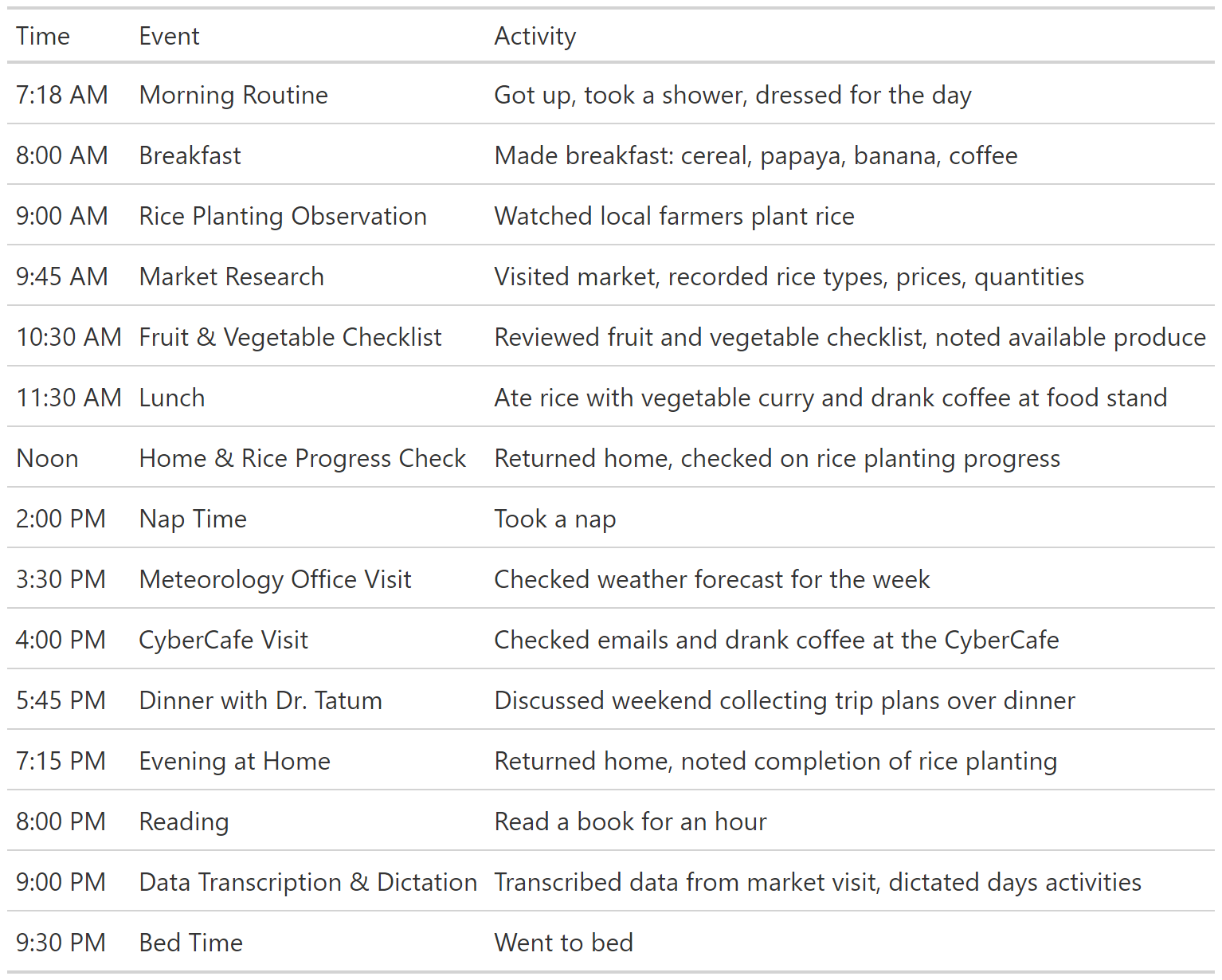
Note that I didn’t need to do the table in R. ChatGPT4 made a nice table. What I was testing is whether it is straightforward to bring the data into R for further analysis. For example, I’m going to experiment by making a timeline of the activities.
The summary table extraction met my expectations.
Data Extraction
A section of the same publication was used to see if it is possible to extract information.
Extract the scientific names in the following text and present these in an alphabetized list.
Gastrointestinal problems
One hundred three uses (including diabetes), corresponding to 96 species were registered, thus making gastrointestinal problems the major health issue treated with plants.
The main indication related to gastrointestinal disorders is stomach pain (29 use reports). Twenty-nine species were found to be useful in case of gastritis with moderate to severe pain, and stomach ulcers. Indeed, gastritis is a very common health problem in Laos, especially among men. According to some interlocutors, this may be due to the habit of drinking too many alcoholic drinks of poor quality. In one recipe, different plant species are combined for more efficiency (i.e. Hedyotis capitellata Wall ex G. Don, Senna alata (L.) Roxb., Embelia ribes Burm.f., Aphanamixis polystachia (Wall.) R. Parker). Bleeding ulcers together with acute stomach pain are preferably treated with species from the Iridaceae family (Eleutherine spp., Iris collettii Hook.f). Four species of Zingiberaceae (Kaempferia spp., Curcuma sp.) were said to be useful in the case of chronic pain due to an excess of alcohol. In Laos, pills are processed with Eleutherine subaphylla Gagnep. bulb, Curcuma longa L., Zingiber montanum rhizome and sold for gastritis and stomach ulcers [15]. All treatments should be taken internally, and repeatedly over time to cure the problem.
Twelve plant species were reported to be useful in case of liver problems, mainly jaundice, or swollen tough and painful liver, associated with difficulty in breathing. To treat swollen liver, Aglaonema simplex (Blume) Blume, Angiopteris ceracea Alderw, Clerodendrum glandulosum Lindl., Selliguea sp., are mashed or finely grated and prepared in poultice form, placed directly in situ, and renewed everyday. Liver problems including hepatocarcinomas are highly prevalent in Lao PDR as well as neighboring countries, and it has been shown that because no effective treatments exist, people turn to traditional medicine and traditional healers [44].
Among all the species listed in this survey, Oroxylum indicum (L.) Kurz is a Bignoniaceae species also widely used for liver-related problems in Lao PDR, China, Vietnam, and Cambodia. Its methanolic, ethanolic, and aqueous bark and wood extracts have been shown to have hepatoprotective properties [45] and to contain antiproliferative compounds against the carcinogenic HepG2 cell line [46]. The mushroom Ganoderma lucidum (Curtis) P. Karsten growing on decaying woods, together with the small upland orchid Anoectochilus lylei Rolfe ex Downie, both cited in this survey, are highly prized ingredients for serious liver problems. Potential pharmacological activities of G. lucidum have been much sought after in the field of cancer, neurology, and immunomodulation, thus making this fungus widely used in alternative medicine over the world [47]. This high demand generated the necessity for large-scale cultivation [48], but in Lao PDR, this forest fungus is still collected from the wild in large quantities. Now becoming scarce, its retail market price is quite high.
Diabetes is a health condition recognized as a major concern by our interlocutors. It was stated that diabetes can be diagnosed when drops of urine poured on the floor attract ants (because of their sweet taste) and also when the person needs to drink a lot of water. Plants said to be bitter (Tinospora crispa (L.) hook. f. Thomson, Solanum torvum Sw.), or to possess the five tastes (sweet, sour, salty, bitter, and acrid) such as Phyllanthus emblica L. fruits are much favored for this condition. Decoctions of these plants drunk during the day are thought to help to regulate the blood sugar level.
Here is an alphabetized list of the scientific names mentioned in the text:
Aglaonema simplex (Blume) Blume
Aphanamixis polystachia (Wall.) R. Parker
Angiopteris ceracea Alderw
Anoectochilus lylei Rolfe ex Downie
Clerodendrum glandulosum Lindl.
Curcuma longa L.
Curcuma sp.
Eleutherine spp.
Eleutherine subaphylla Gagnep.
Embelia ribes Burm.f.
Ganoderma lucidum (Curtis) P. Karsten
Hedyotis capitellata Wall ex G. Don
Iris collettii Hook.f
Kaempferia spp.
Oroxylum indicum (L.) Kurz
Phyllanthus emblica L.
Senna alata (L.) Roxb.
Selliguea sp.
Solanum torvum Sw.
Tinospora crispa (L.) Hook. f. Thomson
Zingiber montanum
Zingiberaceae (Kaempferia spp., Curcuma sp.)
Not perfect, but a really helpful start.
Survey Planning
You are planning a study of ethnic street vendors in the US who sell different kinds of chili peppers. You want to find out if their background influences the types of peppers they sell. What survey questions would be appropriate?
To design an effective survey for studying ethnic street vendors in the US and their chili pepper offerings, it's important to focus on questions that address their background, the types of chili peppers they sell, and any factors that might influence their choices. Here's a list of potential survey questions:
What is your age?
What is your gender?
What is your country of origin?
How long have you been living in the United States?
How long have you been a street vendor?
How did you learn about the chili peppers you sell? (Family recipes, traditional knowledge, research, etc.)
What types of chili peppers do you sell? Please list them.
How do you decide which chili peppers to sell?
Do you think your ethnic background influences the types of chili peppers you sell? If yes, please explain how.
Are there any specific cultural or regional dishes that you prepare using the chili peppers you sell?
Do you collaborate or network with other street vendors of a similar ethnic background? If yes, how do you share information and resources?
How do you source the chili peppers you sell? (Locally grown, imported, etc.)
Do you sell any other products that are specific to your cultural background? If yes, please list them.
Do you notice a demand for specific chili peppers based on the ethnic background of your customers? If yes, please provide examples.
Are there any challenges you face as an ethnic street vendor selling chili peppers in the United States? If yes, please describe them.
By asking these questions, you will be able to gather data on the ethnic background of the street vendors, the types of chili peppers they sell, and any potential influence their background may have on their product offerings.
Do I need to get IRB approval for this research? I intend to publish the results in a scientific journal.
If you plan to conduct research involving human subjects and intend to publish the results in a scientific journal, it is generally necessary to obtain approval from an Institutional Review Board (IRB) or an equivalent ethics committee. The purpose of the IRB is to ensure that research involving human subjects is conducted ethically, protects the rights and welfare of the participants, and complies with applicable regulations.
In the case of your study on ethnic street vendors and their chili pepper offerings, you are gathering information from human subjects, which makes it fall under the category of research that typically requires IRB approval. To obtain approval, you'll need to submit a research protocol outlining your study's purpose, methodology, participant recruitment, data collection, and data analysis, as well as measures to protect participants' privacy and confidentiality.
Keep in mind that IRB requirements and procedures can vary depending on the institution, so it's essential to consult the specific guidelines and procedures of the IRB or ethics committee affiliated with your research. If you are unsure whether your study requires IRB approval, it's always a good idea to consult with the IRB or an experienced researcher for guidance.
How do I determine the minimum sample size for my study?
Determining the minimum sample size for your study depends on several factors, including the study design, the desired level of statistical power, the expected effect size, and the acceptable margin of error. One common method to calculate the minimum sample size is by using power analysis, which helps you balance the risks of Type I and Type II errors, achieve the desired level of statistical power, and ensure that the study results are meaningful and generalizable.
Here are the steps to determine the minimum sample size for your study:
Identify the study design: Consider whether your study is a descriptive, correlational, or experimental design, as different designs require different sample size calculations.
Define the effect size: The effect size is a measure of the magnitude of the relationship between variables or the size of the difference between groups. You can use previous research or expert opinions to estimate the expected effect size. A larger effect size requires a smaller sample size, whereas a smaller effect size requires a larger sample size.
Determine the desired level of statistical power: Statistical power is the probability of correctly rejecting the null hypothesis when it is false. A common convention is to set the power at 0.80 (or 80%), which means that there is an 80% chance of detecting a significant effect if it exists.
Set the significance level (alpha): The alpha level represents the probability of committing a Type I error, which occurs when the null hypothesis is rejected when it is true. A common alpha level is 0.05 (or 5%), indicating a 5% chance of committing a Type I error.
Select the appropriate sample size calculation formula or software: Depending on your study design, you can use different formulas or software to calculate the minimum sample size. Examples of software programs include G*Power, PASS, and nQuery.
Input the parameters: Enter the effect size, desired level of statistical power, and significance level into the chosen formula or software.
Calculate the minimum sample size: The output will provide you with the minimum sample size required to achieve the desired level of statistical power, given the expected effect size and significance level.
Keep in mind that practical considerations, such as time and resources, may affect your final sample size. Additionally, you may need to account for potential attrition or nonresponse by increasing the sample size accordingly. It's also a good idea to consult with a statistician or an experienced researcher when determining the appropriate sample size for your study.
What are the different varieties of chili peppers sold in New Mexico?
New Mexico is well-known for its chili peppers, and various varieties are grown and sold throughout the state. Some of the most popular chili peppers in New Mexico include:
New Mexico chile (also known as Hatch chile or Anaheim chile): This is a broad category of chili peppers that includes several cultivars, such as Big Jim, Joe E. Parker, Sandia, and Española Improved. They can vary in heat levels, from mild to hot. New Mexico chiles are often used for making green and red chile sauces, as well as for roasting and stuffing.
Pueblo chile: Grown in the southern Colorado region, this chile variety is also popular in New Mexico. The Pueblo chile is known for its thick flesh, making it ideal for roasting and using in various dishes.
Chimayo chile: This heirloom chile variety is native to the historic town of Chimayo in northern New Mexico. It is known for its rich, earthy flavor and medium heat. Chimayo chiles are often used in traditional New Mexican cuisine, especially for making red chile sauce.
Sandia chile: Named after the Sandia Mountains, this variety is a type of New Mexico chile with a more moderate heat level. It is often used for roasting, making sauces, or drying and grinding into powder.
Jalapeño: This popular chili pepper is also grown and sold in New Mexico. Jalapeños have a moderate heat level and are versatile in various dishes, including salsas, pickling, and stuffing.
Serrano: Serrano peppers are hotter than jalapeños and commonly used in Mexican and New Mexican cuisine. They are great for salsas, guacamole, or adding heat to any dish.
Habanero: Known for its intense heat, the habanero pepper is also available in New Mexico. Use it sparingly to add a burst of heat to salsas, hot sauces, and other dishes.
Bhut Jolokia (Ghost Pepper): While not native to New Mexico, the ghost pepper is sometimes grown and sold in the state. This extremely hot chili pepper is used in small amounts to add intense heat to hot sauces and other dishes.
These are just a few examples of chili pepper varieties that you might find in New Mexico. Keep in mind that availability may vary depending on the season, location, and individual growers.
Where can I find the production statistics for the chili peppers grown in New Mexico?
To find production statistics for chili peppers grown in New Mexico, you can consult the following sources:
United States Department of Agriculture (USDA) National Agricultural Statistics Service (NASS): NASS conducts surveys and publishes data on agricultural production, including chili pepper production in different states. You can access their data and reports on their website (https://www.nass.usda.gov) or check the New Mexico State Agriculture Overview (https://www.nass.usda.gov/Quick_Stats/Ag_Overview/stateOverview.php?state=NEW%20MEXICO).
New Mexico Department of Agriculture (NMDA): The NMDA is another source of information on agricultural production in New Mexico, including chili pepper production. You can visit their website (https://www.nmda.nmsu.edu) and look for reports and data on chili pepper production in the state.
New Mexico Chile Association (NMCA): The NMCA is a non-profit organization representing New Mexico chile growers, processors, and manufacturers. They may have data and information related to chili pepper production in the state. Visit their website (https://www.nmchileassociation.com) and reach out to them for more information.
Cooperative Extension Service: The New Mexico State University Cooperative Extension Service may provide information on chili pepper production in the state. They publish articles, reports, and guides related to agriculture in New Mexico. You can visit their website (https://aces.nmsu.edu/ces) and search for chili pepper production data or contact their local offices for more information.
Academic publications and research reports: You can also look for scholarly articles, research papers, and reports on chili pepper production in New Mexico. Online databases like Google Scholar, Web of Science, or agricultural journals can be helpful in finding relevant publications.
Remember that data may not be available for every year, and different sources may provide different levels of detail. You may need to compile and cross-reference data from multiple sources to get a comprehensive view of chili pepper production in New Mexico.
Public Health Data
This is a test of gathering public health data. More specifically, data for different “resolutions,” such as national versus local (state).
What is a reliable source of data for infant mortality for communities within the state of Utah?
A reliable source of data for infant mortality rates for communities within the state of Utah would be the Utah Department of Health (UDOH). The UDOH maintains various health statistics, including birth and death records, which can be used to calculate infant mortality rates. The UDOH's Indicator-Based Information System for Public Health (IBIS-PH) provides access to health-related data at the state and community levels. You can access this information on their website (https://ibis.health.utah.gov) or contact them directly for more specific data requests.
Another potential source of infant mortality data is the Centers for Disease Control and Prevention (CDC) National Center for Health Statistics (NCHS). While the NCHS provides national-level data, it may also offer some state-level data or direct you to appropriate resources for more localized information. The CDC's website (www.cdc.gov/nchs) is a valuable resource for health-related data.
Is infant mortality measured the same way in all the US states?
Yes, infant mortality is generally measured consistently across all U.S. states. Infant mortality is defined as the number of deaths of infants under one year of age per 1,000 live births during a given year. This measure is widely used as an indicator of the overall health and well-being of a population and allows for comparisons between states and countries.
The collection of data on infant mortality is facilitated by the National Vital Statistics System (NVSS), which is maintained by the National Center for Health Statistics (NCHS), a part of the Centers for Disease Control and Prevention (CDC). The NVSS gathers data from vital records, including birth and death certificates, which are reported by individual states. Although there may be some variations in data collection and reporting practices among states, the NCHS provides guidelines and standard definitions to promote consistency across the country.
Which counties are at the extreme ends of the infant mortality distribution?
As an AI language model, I am unable to provide real-time or current data. However, I can give you a general idea of how to find this information.
Infant mortality rates can vary significantly between counties, even within the same state. To find the counties with the highest and lowest infant mortality rates in the United States, you would need to access the most recent data from the National Center for Health Statistics (NCHS) or the Centers for Disease Control and Prevention (CDC). The NCHS's National Vital Statistics System (NVSS) is a primary source for county-level data on infant mortality.
Another resource for county-level health data is the County Health Rankings & Roadmaps program, a collaboration between the Robert Wood Johnson Foundation and the University of Wisconsin Population Health Institute. Their annual County Health Rankings report provides a snapshot of health outcomes, including infant mortality rates, for nearly every county in the U.S. You can access their data and reports at www.countyhealthrankings.org.
Please note that specific counties with the highest and lowest infant mortality rates may change over time as new data becomes available and as public health interventions are implemented.
How did the infant mortality in the US change in the early part of the 20th century?
In the early part of the 20th century, the United States experienced a significant decline in infant mortality rates. This decrease was primarily due to improvements in public health measures, medical advancements, and living conditions.
Some key factors that contributed to the decline in infant mortality during this period include:
Improved sanitation and hygiene: The introduction of water treatment systems, better sewage disposal, and widespread adoption of personal hygiene practices contributed to a reduction in waterborne and foodborne diseases, which were common causes of infant deaths.
Advances in medical knowledge and healthcare: Developments in the understanding of infectious diseases, the discovery of antibiotics, and the expansion of vaccination programs helped control and prevent many childhood illnesses. Prenatal and postnatal care also improved, leading to better maternal and child health outcomes.
Improvements in nutrition: Better access to a variety of nutritious foods and the introduction of pasteurized milk helped reduce malnutrition and related health issues among infants and children.
Public health interventions: Health education campaigns, public health programs, and the establishment of agencies like the U.S. Children's Bureau in 1912 contributed to raising awareness about infant and maternal health and implementing evidence-based practices to improve health outcomes.
Socioeconomic advancements: As the standard of living increased in the U.S., families had better access to housing, education, and healthcare, which positively impacted infant mortality rates.
These factors, combined with ongoing efforts in public health and medical research, led to a steady decline in infant mortality throughout the 20th century. The trend has continued into the 21st century, although disparities still exist across different populations and regions within the U.S.
Where can I get some numbers in a format that can be used in a statistical plotting program like R?
To obtain infant mortality data in a format that can be used in a statistical plotting program like R, you can access publicly available datasets from reputable sources. Here are a few options:
Centers for Disease Control and Prevention (CDC) - National Center for Health Statistics (NCHS):
The NCHS provides the National Vital Statistics System (NVSS), which offers annual datasets on births, deaths, and infant mortality. Data files can be downloaded in CSV, SAS, or other formats that can be imported into R.
Website: [https://www.cdc.gov/nchs/data_access/vitalstatsonline.htm
]{.underline}National Bureau of Economic Research (NBER):
NBER offers vital statistics data, including infant mortality rates, in machine-readable formats. You can download datasets in CSV or other formats and import them into R.
Website: [https://www.nber.org/research/data/vital-statistics-historical-time-series
]{.underline}County Health Rankings & Roadmaps:
This program provides county-level health data, including infant mortality rates, which can be downloaded as Excel or CSV files. These files can be imported into R for further analysis.
Website: [https://www.countyhealthrankings.org/explore-health-rankings/rankings-data-documentation
]{.underline}Data.gov:
Data.gov is a repository of datasets from various government agencies, including health data. You can search for infant mortality data and download it in CSV or other formats to import into R.
Website: [https://www.data.gov
]{.underline}Once you have downloaded the desired dataset, you can use R's built-in functions like read.csv() or read.table() to load the data into R and manipulate it using various statistical and visualization packages, such as ggplot2, dplyr, or tidyverse.
I did a small bit of checking and it appears that the web sources are real.
Note that on the last question, in particular, ChatGPT remembers that the discussion is about infant mortality. That's an important feature of this system.
Creating a Grading Rubric
I need a rubric for a course where each student will submit 10 photos. The grading will involve technique, composition, and fidelity to the assignment's theme. The rubric should provide point scores for a variety of aspects of the grading.
Title: Photography Course Rubric
Objective: Assess students' submitted photos based on technique, composition, and fidelity to the assignment's theme. Each student will submit 10 photos.
Total Points: 100 points
Grading Criteria:
1. Technique (30 points)
a. Exposure (10 points)
i. Perfect exposure: 10 points
ii. Minor exposure issues: 7 points
iii. Major exposure issues: 4 points
iv. Unusable exposure: 0 points
b. Focus (10 points)
i. Perfect focus: 10 points
ii. Minor focus issues: 7 points
iii. Major focus issues: 4 points
iv. Unusable focus: 0 points
c. Color Balance (10 points)
i. Perfect color balance: 10 points
ii. Minor color balance issues: 7 points
iii. Major color balance issues: 4 points
iv. Unusable color balance: 0 points
2. Composition (40 points)
a. Rule of Thirds (10 points)
i. Excellent use of rule of thirds: 10 points
ii. Good use of rule of thirds: 7 points
iii. Poor use of rule of thirds: 4 points
iv. No use of rule of thirds: 0 points
b. Framing (10 points)
i. Excellent framing: 10 points
ii. Good framing: 7 points
iii. Poor framing: 4 points
iv. No framing: 0 points
c. Balance (10 points)
i. Perfect balance of elements: 10 points
ii. Good balance of elements: 7 points
iii. Poor balance of elements: 4 points
iv. No balance of elements: 0 points
d. Visual Impact (10 points)
i. Strong visual impact: 10 points
ii. Moderate visual impact: 7 points
iii. Weak visual impact: 4 points
iv. No visual impact: 0 points
3. Fidelity to Assignment's Theme (30 points)
a. Adherence to Theme (20 points)
i. Perfect adherence to theme: 20 points
ii. Good adherence to theme: 14 points
iii. Poor adherence to theme: 8 points
iv. No adherence to theme: 0 points
b. Creativity (10 points)
i. Highly creative interpretation of theme: 10 points
ii. Moderately creative interpretation of theme: 7 points
iii. Weakly creative interpretation of theme: 4 points
iv. No creativity in interpretation of theme: 0 points
Total Points Breakdown:
- 90-100 points: A
- 80-89 points: B
- 70-79 points: C
- 60-69 points: D
- Below 60 points: F
Socially-Relevant Ecology Course
I am developing a new undergraduate-level college course on the broad topic of "ecology." I believe that there should be some socially-relevant topics presented, but most of the course should focus on the science of ecology. There will be 22 lectures. I need a list of appropriate lecture titles.